

Minnesota assumed name search finds the certificate that ties a trading name to the business behind it. An assumed name, sometimes called a DBA or a trade name, lets an existing entity or a sole proprietor operate under a brand without forming a second company. The Secretary of State’s register holds those certificates beside the legal names, and a lookup returns the owner, the brand, and the term.
This page covers the search, the fields on a certificate, the filing that creates one, the renewal that keeps it alive, the difference between a brand and a legal name, and the point at which a trademark question replaces a register question. It is written for owners adding a brand and for buyers tracing a storefront back to an entity.
How to Search Minnesota Assumed Names
The portal includes assumed names in the same result list as entities, so a name search returns both. A reader can also open the assumed name index directly and read the certificate on its own. The lookup is free, and no login is needed. A brand in any county can be reached through the same front door, where Minnesota assumed name search opens the register.
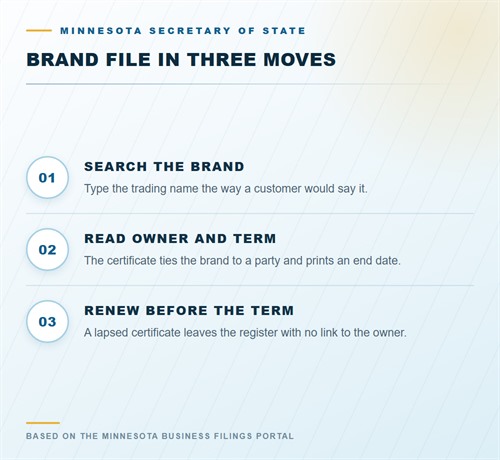
The register mixes brands and legal names in one list, so a reader should read the type field before opening a result. An assumed name entry names the owner, while an entity entry names the company itself. The Minnesota name records page covers the legal name side of the same register.
Search by Brand Name
Enter the trading name as a customer would say it, and the list shows the certificate with the owner beside it. A brand that returns nothing may be unregistered, or it may sit under a slightly different spelling. Try the distinctive word alone before concluding that no certificate exists.
A brand that a customer types into a search engine may appear nowhere in the register, because a certificate is not a website. A reader who needs the owner should search the register rather than the open web, where a directory can rank above the state record.
Search by Owner
A search on the legal entity name returns the entity record and the certificates filed by that owner, which is the route a buyer uses when the brand is unknown but the company is named in a contract. The certificate then names the trading name and the term. A brand that does not appear may belong to a different legal name in the same group.
Read the Certificate
The certificate shows the assumed name, the owner, the address, and the filing date. It does not show the ownership of the entity, and it does not show a trademark. Read the owner field first, because the owner is what a customer or a court needs to trace.
The certificate carries no seal and no certification, so a reader who needs evidence for a bank orders a certified copy. The plain record shows the link, and the certified copy proves it. The two serve different purposes in a file. A copy ordered after the brand has lapsed will show the expired term, which is itself useful in a diligence note or a purchase file.
Minnesota assumed name forms:
https://www.sos.mn.gov/
What a Certificate Shows
A certificate is a disclosure rather than a grant of rights. It records that a named owner is trading under a named brand, and it gives the public a way to find the owner. It does not reserve the brand against another business, and it does not create a company.
A certificate is short, and its value is in the link it creates rather than in the detail it carries. The owner field is the one a reader needs most, because it points to the entity record and the status. A certificate with a vague owner is a certificate with no use.
Owner and Address
The owner field names the entity or the individual behind the brand, and the address field gives the place of business. A buyer who checks a storefront should compare the address on the certificate with the address on the invoice. A mismatch is a reason to ask a question.
Term and Filing Date
The filing date starts the term, and the certificate runs for a set number of years. The term matters when a brand has been in use for a long time, because an expired certificate leaves the brand unregistered. The filing date also shows whether the brand predates a contract.
A brand that has been in use for a decade may sit on a certificate that has been renewed several times. The filing date shows the first registration, and the renewal shows the current term. A buyer who needs the history orders the copies rather than relying on the current page.
What It Does Not Show
The certificate does not show revenue, ownership percentages, or the entity’s status. A reader who needs those facts opens the entity record behind the owner. A certificate alone is a link, not a profile.
A certificate does not show whether the owner is active, so a reader has to open the entity record beside it. A brand linked to a dissolved owner is a warning in a purchase. The two records belong in the same note.
Filing a Certificate
A business files a certificate when it trades under a name that differs from its legal name. The form names the owner, the brand, and the address, and it is signed by an authorized person. The office accepts the document and posts the certificate to the register.
A business should file the certificate before the new sign goes up, because a customer who searches the brand during the first week should find the owner. A filing made after the launch leaves a window in which the brand has no link. The window is short, and the cost of closing it is small.
Who Files
An LLC, a corporation, a partnership, or a sole proprietor can file. The owner must be a real party, and the certificate has to name it accurately. A brand filed under the wrong owner creates a link that points to the wrong file.
A certificate filed by an entity should be signed by a person with authority under the articles or the operating agreement. A signature from someone without authority can be questioned later. The Minnesota name availability page covers the check that a founder runs before adopting a brand.
What to Include
The form asks for the assumed name, the owner, the address, and the signature. A business with several brands files a separate certificate for each one, because each carries its own term. The confirmation belongs with the entity records.
A certificate that names the wrong owner is worse than no certificate, because it points a reader to the wrong file. The form should be checked against the formation document before it is signed. A corrected certificate is a new filing with a new charge.
Renewal and Expiry
An assumed name ends at the close of its term unless a renewal arrives. The renewal is a short document with its own charge, and the owner has to be current to file it. A lapsed certificate leaves the brand unregistered even when the business keeps using it.
A renewal is cheaper than a reinstatement, and the difference is the delay rather than the paperwork. A business that tracks the term date in the same calendar as the annual renewal avoids both. A lapsed certificate can be restored, and the register will show the gap.
Filing the Renewal
The renewal names the certificate and the owner and carries the current charge. A renewal filed before the term ends keeps the certificate current without a gap, while one filed after the term may need a reinstatement, which costs more and shows the lapse. No reminder follows a change of owner, so a calendar note at the term date is the cheaper control. A brand retired from use should be cancelled rather than left to expire on the record.
After a Lapse
A business that lets a certificate lapse can still trade, but the register no longer links the brand to the owner. A buyer who checks the register will not find the brand, which can look like an unregistered business. A reinstatement restores the link and shows the gap, which is what a buyer reads when the brand matters to the deal. The gap is small in most cases, the reinstatement fee is higher than a renewal, and a calendar note is the cheaper control.
Assumed Name and Legal Name
The legal name is the one the entity filed, and the assumed name is the brand a customer sees. The two can differ, and the certificate is what connects them. A contract should use the legal name, while a sign can use the brand.
A reader who compares a certificate with an invoice should check the owner and the address, because the brand can match while the owner does not. A brand sold with the business needs a new certificate, and a certificate that still names the seller is a warning.
In a Contract
A contract that names only the brand can leave a reader unsure which entity signed. The safer wording names the legal entity and adds the assumed name in parentheses. The certificate supports that wording when a dispute arises.
On a Sign and a Website
A sign can carry the brand, and a website can carry the brand, as long as the business holds a certificate. A customer who searches the brand should find the owner through the register. A brand with no certificate gives the customer no route.
Assumed Names for Entities
An LLC or a corporation files an assumed name certificate when it wants a shorter brand. The entity remains the owner, and the certificate sits beside its record with a term of its own and its own renewal date.
Multiple Brands
A company that markets several products under different names should list each certificate in its own file, because each one expires on its own schedule. A buyer who reviews the business should see the full set, since a missing certificate is a brand with no link, and the list also shows which brands are current, which saves a second search.
A company with several brands should confirm that each certificate names the current legal entity, because an older certificate may still name a former name. A brand linked to a former name is a question in a diligence file. The correction is a new certificate rather than an amendment.
Change of Owner
A sale of the business calls for a fresh certificate, because the owner field has to match the new party, and an owner field left in the seller’s name is a defect a buyer inherits at closing. The form is brief, the wait is the only cost, and a buyer should check the certificate against the closing date at the time of the sale, since a filing made the same week removes a later argument about who held the brand.
Assumed Names for Sole Proprietors
A sole proprietor can file an assumed name without forming an entity, and the certificate names the individual. That route is the lightest way to trade under a brand, and it carries no liability shield. A proprietor who later forms an LLC files a new certificate under the entity and cancels the old one, because two certificates for the same brand create a question about the owner.
When to Use It
A proprietor who operates under a brand and wants a bank account in that name usually needs a certificate, and the bank checks the owner against the identification and the certificate. A certificate with no entity behind it is enough for a small trade, while a missing one delays the account. A proprietor who trades under two brands files two certificates, because each brand carries its own term and its own owner line.
Limits
The certificate does not protect the proprietor from a claim, and it does not separate the business from the person. A reader who needs a liability shield should look at an entity, not at a brand. The certificate is a disclosure rather than a structure.
A proprietor who uses a brand without a certificate can still trade, but the register offers no link for a customer or a bank. The certificate is the cheapest form of disclosure available, and the bank usually asks for it. It does not replace a local licence, and a city may ask for both before it issues a permit. Filing it before the first invoice avoids a later explanation to a client who checks the register and finds nothing. The form takes a few minutes, and the acknowledgment belongs with the tax records rather than in a drawer. A copy kept beside the business licence answers the same question twice.
When a Brand Conflict Arises
A certificate does not settle a brand conflict, because another business can hold a federal mark or an earlier local use. The register is one piece of the check, and the trademark search is the other. A conflict usually starts with a letter rather than with the office.
A conflict often begins with a letter from another business rather than with a filing at the office. The certificate in hand is the first document a lawyer asks for, and the entity record is the second. A reader who keeps both can answer the letter without a search. A letter that names the certificate number and the earlier use is easier to answer than one that names only the sign above a door.
Earlier Local Use
A business that used a brand without registering it can still hold rights in its area, and a later filer who registers the same brand does not erase that use. The certificate does not defeat the earlier right, so a founder who plans to compete in the same town should ask a lawyer before the launch.
Federal Marks
A federal registration gives the owner a stronger position across the country. A brand that clears the state register can still infringe a federal mark. A founder who plans to expand should search the federal register before the certificate is filed.
A federal search takes a few minutes and shows whether a similar mark is registered or pending in the same class. A state certificate does not answer that question, and a launch that skips the search can end in a rebrand. The search is the cheaper of the two outcomes.
Assumed Name Fees
The office publishes a charge for the certificate and the renewal, and the amounts below cover the filings a business is most likely to order. A mailed filing costs less than an online one. A reinstatement after a lapse costs more than a timely renewal.
| Assumed name filing | Online | |
|---|---|---|
| Certificate of assumed name | $30 | $50 |
| Amendment | $30 | $50 |
| Annual renewal | $0 | $0 |
| Reinstatement after a lapse | $65 | $85 |
| Cancellation | $0 | $0 |
| Good standing certificate | $5 | $15 |
Frequently Asked Questions
The questions below come from owners adding a brand, buyers tracing one, and proprietors deciding whether a certificate is needed.
Is the assumed name search free?
Nothing is charged for a lookup, and no login is required. Costs begin with a certificate, a renewal, or a copy.
Does a certificate protect my brand?
No. It records the link between the brand and the owner. A federal mark or an earlier local use can still take precedence.
How long does an assumed name last?
The certificate lasts a set number of years and lapses without a renewal, so a calendar note at the term date protects the link.
Can two businesses use the same assumed name?
The office does not compare assumed names for distinguishability in the same way it compares entity names. A conflict is settled in the market or in court.
Do I need an assumed name for my LLC?
A certificate is needed only where the sign differs from the legal name. Where the two match, the entity record already carries the brand.