

Minnesota business records search is the lookup a buyer runs when a register printout is not enough and the document trail matters. The Secretary of State’s office holds the formation filings, amendments, renewals, mergers, and closures for every entity in the state, and the portal publishes that history for anyone to read. A request returns the name, the number, the class, the condition, and the documents on file.
This page covers the search itself, the fields on a record, the copies and certified copies a buyer can order, the records that sit outside the office, and the way a diligence file is built from more than one source. It serves buyers, lenders, attorneys, and owners who need to prove what a company filed rather than guess at it.
How to Search Minnesota Business Records
The portal accepts a business name, a file number, or a phrase, and the record opens from the result list. The name route suits a reader who knows the company but not its state number, while the number route suits a reader holding a certificate or a renewal notice. Neither route requires an account, and the lookup costs nothing. Every document named on this page sits in the register that Minnesota business records opens from the front page.
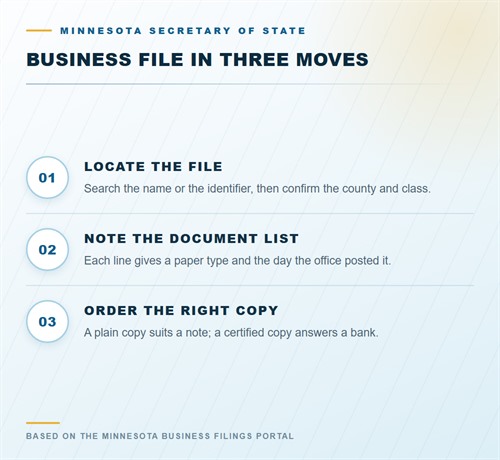
Entities and brands share one index, so the class field separates a profit corporation from a nonprofit or an LLC. A reader who searches a name may see several classes and an assumed name in the same result. The note should carry the number, the class, and the office for each close match.
Search by Business Name
Start with the identity term and set the ending aside on the first pass. A query for “Red River” returns every entity and assumed name that carries those words, which is the list a reader needs to spot a close match. Open the record whose registered office or agent matches the paperwork in front of you, because a similar name can belong to an unrelated business in another county.
Search by File Number
The office issues the number when it accepts the formation document, and the entity keeps it for as long as the file exists. A reader who has a certificate can enter the number and open the file directly. Copy the number exactly, because a missing digit returns an empty page rather than a near match.
The number is the cleanest identifier on the file, because a company that renamed itself still answers to it. A reader who holds only a trade name should search the assumed name index before giving up. The Minnesota file number page covers the identifier and the records it links.
Read the Document List
The record lists the documents the office has accepted, with a type and a date beside each line. The list is the index to the file, and a reader who needs a specific document notes the type and the date before ordering a copy. A short list on an old company is normal, because early filings were not always recorded in the same way.
Minnesota copy requests:
https://sos.mn.gov/media/2981/certificatecopyrequest.pdf
What a Record Contains
A record is a filing file rather than a business profile. The entry gives the name, the class, the identifier, the condition, the date beside each paper, and the addresses on file. It does not report revenue, employees, lawsuits, or credit history, and a reader who needs those facts has to collect them elsewhere.
A record does not carry a share ledger, a minute book, or an operating agreement. Those papers stay with the company, and a buyer has to request them during diligence. The register proves what was filed with the state, and it cannot prove what the owners agreed among themselves.
Identity Fields
The legal name, the class, and the file number sit at the top of the record. Those three fields identify the file, and a reader should copy all three into any note, because a name alone is ambiguous when several entities share a word. The class also tells you which documents a buyer should request and which renewal schedule applies.
Address Fields
Service is taken at a physical Minnesota address, and the agent is whoever receives it there. A mailing address, where the office shows one, is separate from the office and does not control service. Read the label on each field before sending anything, because a paper delivered to the wrong place can leave a company without notice of a claim.
Status and Dates
The status reports whether the registration is in force, and the dates show when each document posted. A record with a renewal in the current year and an active status is straightforward, while a record with a gap needs a closer read. Compare the status date with the transaction date before you rely on the file.
Copies and Certified Copies
The office provides plain copies and certified copies, and the difference matters to a bank, a court, or another registry. A plain copy reproduces the document, while a certified copy carries a stamp that confirms the copy matches the record. A counterparty that asks for certification will not accept the plain version, even when the text is identical.
A plain copy and a certified copy carry the same text, and the difference is the attestation. A reader who compares the two should look for the stamp, the date, and the name of the office. A copy without a stamp is a copy rather than a certification, whatever the file name suggests.
Plain Copies
A plain copy is enough for internal use, a file note, a conversation with the company, or a working paper in a review. The charge is set per image, and the copy can be downloaded or mailed. The copy carries the text and the register carries the context, so a reader who needs the context should keep the printout with it.
Certified Copies
A certified copy is ordered by document type and filing date, and the request should name both. A clerk who receives a vague request returns it rather than guess, which adds a week to the file. The certification fee is modest, and the turnaround is what threatens a closing date.
When Certification Is Required
A bank that opens an account, a title company that closes a deal, and a foreign registry that accepts a registration usually ask for certification. A court may ask for a certified copy of the articles or an amendment. A reader who is unsure should ask the counterparty which document it will accept before paying for the wrong one.
A certified copy is the version a court and a registry accept, and a plain copy is the version a file note accepts. A buyer who orders the plain copy first often pays twice. Ask the counterparty which it will take before the order goes in.
Filing History and Dates
The history is a timeline, and the timeline answers questions that a single field cannot. A rename, a move, or an agent swap that predates a contract is context for the file, not an inconsistency. A renewal filed after a gap shows a company that recovered, not one that never slipped.
The dates on the record are processing dates rather than postmark dates. A paper sent in December can appear in the file in January, and the entry will carry the later date. A reader who spots a late entry should compare the acknowledgment with the posted date before assuming a late filing.
Reading the Sequence
Read the entries in order and note the date beside each type. An amendment that follows a name change accounts for the earlier name, and an agent notice shows why the address moved. A gap in the sequence is not proof of inactivity, because a mailed filing can post late and a record can be rebuilt.
Documents a Buyer Requests
A buyer usually asks for the formation document, the current renewal confirmation, any amendment that changed the name or the shares, and the certificate of good standing. Those four items show how the entity was created, what changed, and whether it remains in force. A seller who cannot produce them is describing a file that may have gaps.
Documents a Lender Requests
A lender adds the operating agreement or the bylaws, a resolution naming the signers, and a certificate dated within its own limit. The lender is checking authority as well as existence, so the corporate record and the internal documents travel together. A file that answers both questions moves faster.
Records of Dissolved Entities
A dissolved entity keeps its record, and the file remains useful after the closure. The history shows the dissolution date, which is the date a creditor or a buyer compares with a contract. A search on a closed file still returns the agent and the office, which helps a reader trace the chain of succession.
A dissolved record still shows the agent and the office, which is how a reader traces a claim to the last known address. The history shows the closure, and the documents filed before it remain available. A request for a copy of the dissolution names the year and the type.
What the File Still Shows
The record shows the name, the number, the class, the closure date, and the documents filed before the end. It does not show what happened to the assets, and it does not show whether a successor exists. A reader who needs those facts has to look at a merger filing or at the company’s own records.
Successor Records
A merger creates a successor and ends the separate existence of the merging parties, so the successor record carries the obligation. A contract signed by an entity that later dissolved may bind the people behind it, which is why a buyer reads the closure date against the contract date. A certified copy of the merger ties the two files together.
Records the Office Does Not Hold
The office keeps corporate filings, and it does not keep tax accounts, licences, or court files. A reader who reads the file as a clearance can sign with a firm that owes tax or lacks a permit. Each of those facts sits with a different agency, and each one needs its own request.
A complete file adds three more searches to the printout: a tax clearance, a court check, and a licence review. None of them sits in the business register, and each one takes its own request. The file is ready when all four agree.
Tax Records
The Minnesota Department of Revenue holds sales, withholding, and income accounts. A business can be active with the office while owing tax, and a certificate of good standing does not clear the balance. A buyer who needs the tax position should ask the seller for a clearance letter or request one from the department.
Licence and Court Records
Professional credentials sit with the licensing board, food and lodging permits sit with the Department of Health, and local licences sit with the city or county. Judgments and liens sit with the court or the county recorder. None of those appear on the business record, so a serious file adds a search at each office.
Building a Diligence File
A diligence file starts with the register printout and grows with the documents that answer the next question. The printout shows what the office said on a date, and the certified copy proves the text of a filing. The certificate proves the standing, and the internal documents prove the authority to sign.
A buyer should write a one-page summary beside the documents, because the summary is what a lender or a partner reads first. The summary names the entity, the number, the status, and the documents that support each statement. A file with a summary is faster to review than a folder of scans.
Order of Work
Start with the record and the status, then order the documents that the deal needs. A file that begins with the certificate and skips the record can miss a name change or an agent notice. A file that begins with the record and adds the certificate at the end is easier to describe.
What to Keep
Keep the printout with the date, the certificate, the certified copies, and a short note of what each item proves. A reader who returns to the file months later should be able to see the reasoning without reopening the portal, and the note should name the office that issued each item so a question can be routed fast. The note is the part that saves time in a later review.
The summary and the documents belong in one folder with the date of the lookup on the first page, and the office that issued each item should be named beside it. A reader who opens the folder should see what was checked, when, and by whom, without reading every scan.
Ordering Documents
A request can go through the portal or by post, and the posted route is cheaper while the portal is faster. A request names the entity, the document type, and the filing date, and it includes the charge. A rejected request is returned rather than refunded, so the detail matters.
A request that names the wrong document type is returned rather than guessed at. A reader who is unsure should open the record and copy the type and the date exactly as the register shows them. The Minnesota filings and certificates page lists the document types the office issues.
Online Orders
A portal order returns a file to download, and the receipt stays in the account. A certified copy bought online usually carries the same stamp as a posted one. Where a counterparty wants a raised seal, the posted route is slower but still open.
Mailed Orders
A posted request reaches the Saint Paul office with a cheque or money order, and a paper copy comes back by mail. The mailed route adds postal time, which matters when a closing date is fixed. A reader who plans ahead can save the difference in charge without missing the date.
Paper ages better than a screen, and a buyer should keep a scan of every page beside the original order. A folder that names the date and the office for each item answers a question months later without a second request to Saint Paul. The register also shows the office that holds each document, which shortens a later request.
Record Fees
The lookup is free, and the charges below apply to the copies and certificates that support a file. The certificate costs less by mail than online, and a certification carries its own charge. The amounts come from the Secretary of State fee schedule.
| Item | Online | |
|---|---|---|
| Record lookup | $0 | $0 |
| Copy of a record | $3 | $3 |
| Certified copy | $5 | $5 |
| Name reservation | $35 | $55 |
| Certificate of good standing | $5 | $15 |
| Copy of an amendment | $3 | $3 |
Frequently Asked Questions
Buyers, lenders, and owners sent the questions below, and each one asks for the paper behind an entry.
Are Minnesota business records public?
Yes. The register is open to anyone, and a reader can view a record without an account, at any hour and without a reason. Copies and certificates carry a charge.
Can I get a copy of the original filing?
Yes. Order the document by type and filing date, and choose a plain or certified copy depending on who will read it.
Does the record show the owners?
No. Minnesota does not publish a member or shareholder list. The operating agreement or the stock ledger comes from the company.
How far back do the records go?
The register shows the documents the office has on file, and older filings may be incomplete. A request for an early document should name the year and the type.
Can I order a copy for a dissolved company?
Yes. The record remains on file after a closure, and the copies and certificates can still be ordered.
Is a certificate of good standing a record copy?
No. The certificate states the condition on a date. A record copy reproduces a document that was filed.