

Minnesota business status search answers the question a buyer asks first: is this company still in force? The Secretary of State’s register shows the current condition beside every result, and the record sets out how that condition came about. A status of active, inactive, or dissolved changes the way every other field should be read, from the agent to the filing history.
This page covers the status field itself, the events that change it, the difference between an administrative dissolution and a voluntary one, the reinstatement route, and the documents that prove standing to a bank or a landlord. It is written for buyers, landlords, lenders, and owners who need to read a condition rather than guess at it.
How to Check a Minnesota Business Status
The condition sits beside every result, so a reader can filter a list before opening any file. Open the record for the entity you care about, then read the condition with the date of the lookup. A printout from last month describes last month, and a status can change within a season. A reader who needs the whole index rather than one condition can begin at Minnesota business status on the front page.
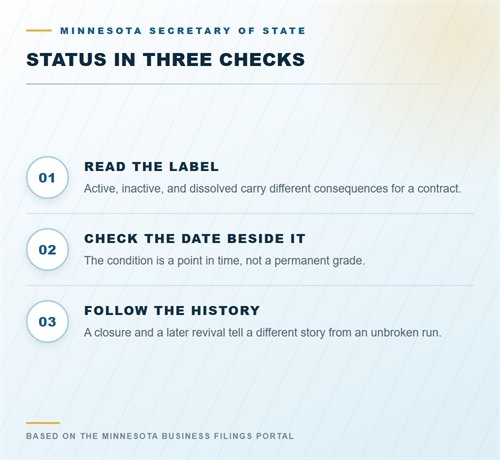
A status check is more useful when the reader saves the record with the date and the class beside it, because the class decides which renewal schedule applies. A printout that shows the condition on the day of the check answers a question months later, when the same record may show a different value. The Minnesota business records page covers the documents that support a deeper review.
Search by Name
Type the core of the name and drop the suffix for the first pass. The list carries the name, number, class, and condition, which is enough to tell a live company from an old record with a similar name. Open the record whose office matches the paperwork in front of you.
Search by File Number
The number is the shortest path when a certificate or a notice is at hand, and the Minnesota file number page covers the identifier in detail. The number never changes, so a company that renamed itself still answers to the same identifier. Paste it without spaces and the record opens directly.
The identifier outlasts a rename, so it beats a name in a search. A trade name may sit in a separate index, which is where a reader should look first.
Read the Status Line
The status sits near the top of the record, beside the file number and the class. A reader should copy the status and the date into the file note, because the pair is what a later question will ask about. A status without a date is only half the fact.
Minnesota renewal rules:
https://www.sos.mn.gov/business-liens/start-a-business/how-to-renew-or-amend-your-business-filing/
What Each Status Means
The label sits beside each result and on the sealed certificate, and a lender reads the paper rather than a screen capture. The value reports compliance, not the quality of the company or its credit.
A reader who weighs two entities should read the condition next to the filing date, since age gives a company more time to slip. A five-year-old entity with a clean history has demonstrated something that a two-month-old entity has not. That difference belongs in the note rather than in the decision alone.
Active
A current entity has renewed and keeps its registration. The file still shows the agent, the office, and the history, and a routine check can rely on it without a second paper. The label says nothing about revenue, and a live company can still be a poor risk.
An active record supports a routine vendor check without further documents, though a bank may still ask for a certificate. The certificate carries a seal and a date, which is what a lender reads. A printout proves what the register said, and the certificate proves what the office certified.
Inactive
A dormant record remains in the register after the filings stop or after the office notes a change. The business may still trade, but the file no longer backs a claim of compliance. Ask for the latest renewal receipt before treating the record as live.
An inactive record is not a closed one, and a reader should ask why the value changed before treating the business as finished. The office can restore an inactive entity through the ordinary renewal, and the history will show the recovery. The label is a snapshot rather than a verdict.
Dissolved by the Office
When a renewal does not arrive, the office can close the registration on its own, and the file records that act. The company may still own property and carry debt, yet the record stops backing a claim of compliance. This is the value readers miss, because no letter goes to the owner.
Voluntarily Dissolved
A voluntary dissolution follows a filing by the owners, and the record shows the date the statement was accepted. The entity ended in the way the statute intends, and the history shows the closure as a deliberate act. A reader who finds one should compare the closure date with the contract date, because an obligation may predate the end of the entity, and creditors can still pursue the company for it.
Reinstated
A reinstated entity is live again, and the record keeps the dissolution beside the reinstatement. A lender reading the file can see that the company lapsed and recovered, which is a different picture from a company that never lapsed. The reinstatement date is the one to compare with a contract date.
The reinstatement date is the one that matters when a contract falls near the gap. A deal signed while the entity was dissolved sits in a different position from one signed after the restoration. Read the dates in order before drawing a conclusion.
Merged or Converted
After a merger the earlier registration ends and a successor carries the assets and duties. The combined file is the one a lender reads.
A merged record is the one a buyer follows when a contract names an entity that no longer exists on its own. The successor carries the obligation, and the earlier record shows the merger as the final entry. The merger document is the paper that links the two registrations for a lender.
What Changes a Status
A status changes through a filing or through the passage of a deadline. The renewal keeps the registration live, while a missed renewal sets a dissolution in motion. A statement of dissolution closes a record on purpose, and a reinstatement reopens it after a lapse.
The office posts a change when it processes a filing, not when the mail arrives. A renewal mailed on December 28 can post in January, and the record will show the later date. A reader who sees a late posting should check the postmark before assuming the company filed late.
The Renewal
The annual report falls due as the calendar year closes, and a live domestic entity sends it at no cost. The filing confirms the office and the agent and keeps the name on the active list. A company that files in December avoids the queue that builds in the final week.
The Missed Renewal
A company that skips the renewal does not lose the record, but it loses the standing that the record was meant to prove. The office posts the dissolution after the period closes, and the status changes without a court order. The gap stays visible even after a reinstatement.
Voluntary Closure
A closure filed by the owners ends the registration on the date the office accepts it. The filing is a statement of dissolution, and it tells the office that the company has wound up rather than lapsed. Creditors can still pursue the business for obligations that predate the closure, and the history keeps the ending beside the earlier papers.
Why Status Matters in a Deal
A status is the first field a bank, a landlord, or a buyer checks, because it decides whether the other documents are worth reading. A contract with a dissolved company may be hard to enforce, and a payment to one may be hard to recover. The check takes a minute and prevents a dispute that takes months.
A status is a starting point rather than a conclusion. A buyer who stops at an active label misses the tax position, the licence, and the court record. Building the file from the register, the certificate, and the other offices is what turns a lookup into a decision.
Contracts and Enforceability
A dissolved company can still owe money, and a contract signed before the dissolution may bind the people behind it. A reader who finds a dissolved status should ask when the closure happened and whether the obligation predates it. The history answers both questions.
Bank and Lender Reviews
A bank usually wants a certificate of good standing dated within the last thirty to ninety days, and it may ask for the renewal confirmation as well. The certificate confirms the condition on its issue date, and the renewal receipt proves the filing. A file with both is easier to approve.
A lender that asks for a certificate usually names the age it will accept, and a file older than that limit is refused even when it is genuine. Order the certificate close to the closing date rather than at the start of the discussion. The certificate speaks to its issue date and to nothing after it.
Licences and Bids
A licensing board may check the status before it renews a credential, and a public bid package often requires a certificate with the submission. A bidder who supplies an old certificate may have to supply a fresh one at the opening. Read the solicitation for the date requirement.
Restoring Good Standing
A dissolved entity returns through a reinstatement filing that follows the missed renewal. The office wants the current renewal and the reinstatement charge, and the record then shows the recovery date. The reinstatement does not erase the gap, and it does not answer a question about what happened during it. It is cheaper than forming a new entity and keeps the file number and the history intact, so a founder who would otherwise start again keeps the formation date and the continuity a lender can read.
What the Filing Requires
The filing names the entity and the renewal that lapsed, and it goes in with the charge. Each missed year is paid at the same time, so the total climbs with the gap. The confirmation should be kept with the earlier notices, because a lender may ask for the sequence.
After the Filing
When the approval lands, the label turns back to active and a fresh certificate shows the change. The history keeps the dissolution and the reinstatement as separate entries, so a reader can see the gap. Request the certificate after the record updates, not before, because an early order may print the old label. Order the certificate after the reinstatement posts rather than on the same day.
Proving Status to a Third Party
A printout proves what the register said on a date, and a certificate proves what the office certified on a date. Most institutions want the second, because it carries a seal and a statement that a counterparty will accept. A screenshot alone rarely satisfies a lender.
A counterparty that asks for proof of standing usually names the document it wants. A bank may ask for a certificate of good standing, while a registry may ask for a certified copy of the articles. Ordering the exact document saves a second fee and a delay at the counter.
Certificate of Good Standing
The paper states that the entity exists and gives its condition on the day of issue. It comes from the portal or by mail and carries a seal a counterparty can check. It does not name owners and does not certify a licence.
Certified Copies
A certified copy repeats a document on the register and carries a stamp confirming the match. A buyer orders one when the exact text of an amendment or a merger matters, and the charge is per certificate.
A certification request names the page and the date it posted. A vague request is sent back, and the return trip is what costs a closing a week. The charge itself is modest, and the date is the part that matters.
Records a Status Check Does Not Cover
A clean status means the filings are in order, and nothing more. The register does not hold tax balances, lawsuits, or customer complaints. A buyer who needs the rest of the picture has to collect it from the Department of Revenue, the courts, and the licensing board that governs the trade.
A serious review adds three searches to the register printout: a tax clearance, a court search, and a licence check. Each one answers a question the register cannot, and each one takes a separate request. The file is complete when all four agree.
Tax Standing
The Department of Revenue keeps its own index, and an active charter does not clear a tax balance. A business can hold an active registration and still owe sales tax, because the two systems are separate and move on different schedules. A buyer who needs the tax position should request a clearance letter rather than infer it from the certificate, since the register answers the corporate question and stops there.
Court and Lien Records
A lien or a judgment is recorded with the court or the county, outside the business file. A status check will not reveal a pending suit, and a clean certificate will not clear a lien. A serious file adds a court search and a lien search beside the register printout.
Printouts and Screenshots
A screenshot carries no date unless the reader adds one, and it carries no seal at all. Save the page as a document with the lookup day printed on it, or order the sealed certificate when a counterparty needs proof. A screen capture can show what a reader saw, but it cannot show what the office certified.
Where a file is shared inside a company, name the person who checked the record and the date of the check. A later reader can then ask that person a question instead of repeating the search, and the note keeps the file from drifting as staff change.
Status Fees
The lookup costs nothing, and the amounts below cover the papers that prove a condition. Order any paper close to the date of use, since each recipient sets a limit on its age. The certificate costs less by mail than online. A certified copy carries its own certification charge.
| Item | Online | |
|---|---|---|
| Status lookup | $0 | $0 |
| Certification of a copy | $5 | $5 |
| Certificate of good standing | $5 | $15 |
| Annual renewal, active entity | $0 | $0 |
| Annual reinstatement, LLC | $65 | $85 |
| Annual reinstatement, assumed name | $65 | $85 |
Frequently Asked Questions
Each question below comes from a reader who needs to read a condition rather than guess. Each reply names the field or the filing involved.
Is the status check free?
Yes. No fee applies to a lookup, and no sign-in is required. Charges start with a certificate, a copy, or a reinstatement.
What does active mean on a Minnesota record?
The renewal is on file and the registration stands. The label reports compliance rather than credit.
Can a dissolved company still do business?
It can still hold assets and owe money, but it lacks authority to trade. A contract signed after the dissolution may be hard to enforce.
How long does reinstatement take?
An online filing usually posts within a few business days, and a mailed filing takes longer. The certificate should be ordered after the record updates.
Does a certificate of good standing expire?
The document has no expiry date, but most institutions require one issued within the last thirty to ninety days.
Why does the record show a gap in the history?
The gap is the period between a dissolution and a reinstatement. The office keeps both entries so that a reader can see when the entity was out of standing.