

A Minnesota corporation is born when the Secretary of State accepts its Articles of Incorporation, and that document becomes the anchor for everything the company files afterwards. The Business and Liens Division holds the charter, the amendments, the renewals, and the closing papers in a single file that anyone can open. One lookup produces the corporate name, the identifier, the class, the condition, the two addresses, and every accepted document.
The sections below follow a corporate file from formation to closure: the classes the office recognizes, the charter document, the directors named at the start, the yearly obligation that keeps the charter alive, the amendments and mergers that alter it, and the published schedule of charges. Officers, buyers, and attorneys can travel the same route, because a corporate file reads the same to every visitor.
How to Search Minnesota Corporation Records
Two boxes do most of the work: one takes the corporate name and the other takes the state identifier. Use the name box when all you have is the style on a sign, and use the identifier when a certificate or a notice carries the number. Neither box asks for a login, and neither charges for the answer. The state register is open from the front page, where Minnesota corporation search lists every class before a reader narrows to charters.
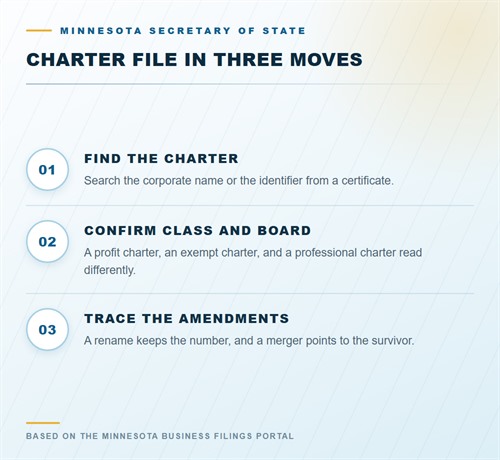
Classes share one result page rather than sitting in separate catalogs, so the class label is the field that distinguishes a share-issuing company from an exempt one. A corporate query can also surface an LLC and a brand that merely borrow the words. The Minnesota nonprofit records page follows the exempt class through the same fields.
Search by Corporate Name
Type the distinctive word and leave the ending for a later pass. A query for “Minnetonka” returns every corporation, LLC, and assumed name that carries the word, which is exactly the list needed to spot a near match. Minnesota compares filed names after the designation is set aside, so a search that includes Inc. or Corp. can hide a record filed as Limited.
Search by File Number
The identifier is stamped on the charter when the office approves it, and no later filing erases it, not even a rename. Take the digits from a state paper rather than from memory, because a guessed number returns nothing and an empty result reads like a missing company. Where only a brand is known, look in the assumed name index before deciding the file does not exist.
Reading the Result List
Every row carries four fields: the name, the identifier, the class, and the condition. A crowded result page usually means the query word was broad, not that the company owns a family of affiliates. Narrow by condition, then by date, and pick the row whose registered office matches the paper in your hand. An old charter with a familiar name can sit on the same page as a live company.
A charter registered in a different county belongs to a different company, however alike the two names look, and the identifier answers the question in a second. Work down the list with a pencil: write the number and the county beside each near match before opening anything, and the notes will keep the comparison straight.
Minnesota corporation forms:
https://www.sos.mn.gov/
What a Corporate Record Shows
A corporate file is a stack of charter papers, not a portrait of a business. Each page records what the company submitted, the day the office took it in, and the addresses and agents the company named along the way. What the file never holds is a customer list, a revenue figure, a lawsuit, or a credit score. It answers three things: whether the charter lives, who takes service, and what has been filed.
Dates turn the file into a chronology, and the chronology is what a careful reader consults before drawing a conclusion. A move, a rename, or a new agent that happened before a contract accounts for an apparent mismatch rather than proving one. A gap followed by a renewal describes a company that came back, not a company that never faltered.
Identity and Class
The legal name, the file number, and the class sit at the top of the record. Minnesota files business corporations, nonprofit corporations, and professional corporations in the same register, and the class changes the form and the charges. A reader who needs the corporate detail should confirm the class before reading the rest, because a nonprofit record does not carry shares.
Status Field
The condition line says whether the charter is live. A current corporation has filed its renewal, while one that falls behind can be dissolved by the office. The field is a point in time, so a printout from last year may describe a condition that no longer holds. Read the printed date beside the condition before a contract rests on either.
Registered Office and Agent
Court papers and official notices land at a street address inside Minnesota, and a named party agrees to accept them there. The place where the company actually works is a separate field, and the two frequently diverge. Confusion between them lets a claim arrive at an office nobody reads. Compare both fields, and open the agent file when a company acts as agent.
Forming a Minnesota Corporation
The incorporating document brings the company into existence, and every later paper points back to it. The organizer enters the corporate name, the street address, the accepting party, the authorized share count, and the names of the first board. The office takes the document in and assigns the identifier, and the charter exists from that day.
One organizer with a free afternoon can complete the charter alone, while a group of shareholders should budget several days for signatures and a word with the bank. Clear the proposed name before anything else, since a refusal wastes a filing. Settle the street address and the accepting party next, and leave the authorized share count for the end.
Articles of Incorporation
The corporate name must carry a recognized ending such as Corporation, Incorporated, or Limited. The registered office must be a physical Minnesota address rather than a post office box, and the agent must be a Minnesota resident or an entity with a street address in the state. A missing signature or a box address is a frequent reason a filing is returned.
Shares and Directors
The articles state the number of shares the corporation may issue and the names and addresses of the initial directors. Shares can be authorized without being issued, which leaves room for later investors. The share figures belong in the corporate record book as well as on the state filing, and a later increase requires an amendment.
Profit, Nonprofit, and Professional
A business corporation issues shares and pays the standard formation charge. A nonprofit has no shares, states its purpose and members, and pays a smaller charge. A professional corporation adds a statement about the licensed service, and the members must hold the credential. The class decides the form and the charge at the outset.
Directors and Officers
Minnesota collects governance data through the articles and the annual renewal, and the public record exposes part of it. The articles name the initial directors, and later filings restate the board when it changes. The register does not publish a shareholder ledger, so the identity of the owners is usually absent from the public file.
A small corporation often has one person in every role, and the record shows that person as incorporator, director, officer, and shareholder. A larger corporation separates the board from management, and the record then shows two lists. The Minnesota business records page covers the documents a buyer should request beside the register printout.
What the Office Publishes
The director fields identify the people who run the corporation, not the people who own it. A change of officers is an internal matter unless the corporation files an update. When a contract is signed by an officer, confirm that the person holds the title the corporation claims, and confirm the status on the day of signing.
The Corporate Record Book
The bylaws, the minutes, and the stock ledger stay with the corporation, and a buyer must request them in diligence. The state file holds the articles, amendments, and renewals, and it is the only part the office can certify. A buyer who needs the ownership list should request the ledger and a signed representation.
The Annual Renewal
The yearly report is the one obligation every live Minnesota charter shares, and a healthy domestic company sends it without a payment. The form repeats the street address and the accepting party, which is how the office confirms the company can still be reached. The deadline is the calendar year end, and the portal accepts the report long before the final week.
Filing early in the final month sidesteps the crush that builds as the year expires, and the acknowledgment shows exactly when the office took it. A group with several charters renews each one on its own, and the account keeps every acknowledgment in one place. Where an agent changed during the year, record the change once, on the renewal or on a separate notice, never on both.
Deadline and Route
The deadline is the last day of December, and the office accepts either an electronic submission or a paper one. The screen opens with last year answers already filled in, and the filer checks each line before sending. Any field that moved during the year has to be corrected at that moment, and the acknowledgment goes into the corporate book.
Why It Is Free
The state frames the yearly report as a compliance statement, not a revenue measure, which is why a live domestic charter owes nothing to remain listed. Money changes hands only when a charter has lapsed and seeks to return, or when a company from another state renews its authority. The structure is the reason neglect ends up costing more than punctuality.
Send the report in the first weeks of January and the remaining eleven months carry no renewal worry; leave it until the end and a lapsed label plus a restoration may follow. Compliance costs a calendar entry and nothing else, and that entry is what small companies misplace.
Losing Good Standing
Skip the yearly report and the office can end the charter on its own authority, leaving a dated closure on the file. Property still belongs to the company and debts still follow it, but the record stops supporting any claim of compliance. A restoration filing revives the charter, and the chronology preserves both the closure and the revival.
What hurts is not the payment but the pause, since a lender, a landlord, or a licensing office can hold a matter until the label changes back.
Restoration
The application names the charter and the report that never arrived, and it travels with the required payment. Once the account clears, the office reviews the papers and puts the charter back on the list. A company returning after the reporting season may also have to send the current year report, and the acknowledgment joins the older notices.
The application and the current report travel together, and the clerk reads them as one submission. No year may remain unpaid before the charter returns, so the bill grows with the time the company spent off the list. Keep the acknowledgment in the corporate book, since a lender often wants the full chain.
Records After Restoration
After the approval, the charter stands again and the caution beside it drops away. A reader sees both the closure and the return, and that story differs from a charter with an unbroken run. Order a fresh certificate once the record updates, and send the copy to whoever raised the question.
Amendments, Mergers, and Conversion
Every change to a corporate file arrives as a document, and each document leaves a mark. An amendment rewrites the name, the street address, the accepting party, or the authorized shares. A merger folds companies together under a survivor, while a conversion moves the charter into another class. The office keeps old papers beside new ones, so the sequence stays readable.
No two filings do the same work. An amendment keeps the charter alive under revised terms, a merger extinguishes the parties that disappear into a survivor, and a conversion swaps one class for another. A correction repairs a typing error without touching the choice it recorded. Follow the documents in sequence before you say anything about who owns the company.
Name and Address Changes
A name change is filed as an amendment and takes effect when the office accepts it. The old name stays in the history, and the new name becomes the one that appears in a search. An address change follows the same route, and an agent change uses a shorter notice. Match the amendment to the current record before changing the file.
Successor Records
A merger creates a successor corporation and ends the separate existence of the merging entities. The successor record carries the combined charter, and the earlier records show the merger as their final entry. A contract signed by a corporation that later merged binds the successor, which is why a buyer traces the chain.
Foreign Corporations in Minnesota
A corporation formed in another state registers in Minnesota before it transacts business in the state. The application requires a certificate of good standing from the home jurisdiction, a Minnesota registered office, and a Minnesota agent. The office issues a certificate of authority when the documents clear, and the entity then renews on the Minnesota schedule.
A registration that begins late still shows the date the authority started, and a penalty can follow a late filing. The home state remains the source of the charter, and the Minnesota record answers only the local authority. A reader who needs the full history should open both records and compare the dates.
Certificate of Authority
The application identifies the home jurisdiction and the date of formation there. The Minnesota authorization date is separate, and a contract can predate it, which matters when a dispute turns on when the corporation was authorized. The agent must hold a Minnesota street address, and a post office box is not accepted.
Withdrawal
A foreign corporation that leaves Minnesota files a withdrawal or a termination of its authority. The record then shows the closure date, and the home-state charter continues. A withdrawal does not dissolve the corporation, and it does not end its obligations in the state. A closed foreign file should send a reader to the home registry.
Corporate Fees
The office publishes a charge for each corporate document, and the list below covers the filings a corporation is most likely to order. Each row shows the mailed amount beside the online amount. A nonprofit formation costs less than a business corporation formation.
| Corporate filing | Online | |
|---|---|---|
| Articles of incorporation, business corporation | $135 | $155 |
| Amendment | $35 | $55 |
| Certificate of authority, foreign corporation | $200 | $220 |
| Annual renewal, domestic corporation | $0 | $0 |
| Change of registered office or agent | $35 | $55 |
| Articles of incorporation, nonprofit | $70 | $90 |
| Copy of a renewal | $3 | $3 |
Frequently Asked Questions
These questions come from officers, buyers, and attorneys who work with Minnesota corporate records. Each reply names the field or the document involved.
Is the Minnesota corporation search free?
Yes. Nothing is charged to open the register, and no login is needed. Costs start with a filing, a certificate, or a copy.
What is the difference between a business and a nonprofit corporation?
A share-issuing corporation pays the standard charge. A nonprofit has no shares, pays less, and files a shorter report, which is why the class field decides the form.
Does a corporation need a Minnesota registered agent?
The appointment has to be a Minnesota resident or an entity that keeps a street address in the state, and the appointment is signed to confirm consent.
Can one person own a Minnesota corporation?
Yes. One incorporator can form the corporation, hold all the shares, and serve as the sole director and officer, though the minute book is still kept.
What happens if the annual renewal is late?
The office can dissolve the corporation, and the record shows the dissolution. Reinstatement requires the renewal and the reinstatement charge.
Does a foreign corporation renew every year?
Yes, a registered foreign corporation files a renewal on the Minnesota schedule and keeps a Minnesota agent for as long as the authority lasts.