

Minnesota business file number search is the fastest route into the state register when a certificate or an old receipt is at hand. The Secretary of State assigns the number when the formation document is accepted, and the number stays with the entity for its whole life. A lookup returns the legal name, the class, the status, the registered office, the agent, and the documents on file.
This page covers the identifier itself, the ways to find it, the difference between the file number and other numbers a business holds, the records the number unlocks, and the cases where a search by name is the only route. It is written for buyers holding a document, owners confirming a filing, and researchers who need the exact record rather than a similar one.
What the File Number Is
The file number is the state identifier for a business entity, and it appears on the certificate the office issues after a formation. It is not a tax number, a licence number, or a federal employer number, and it does not change when the company renames itself. The number is the anchor for every later document the office records. A reader who has lost the digits can still reach the register through Minnesota file number lookup on the front page.
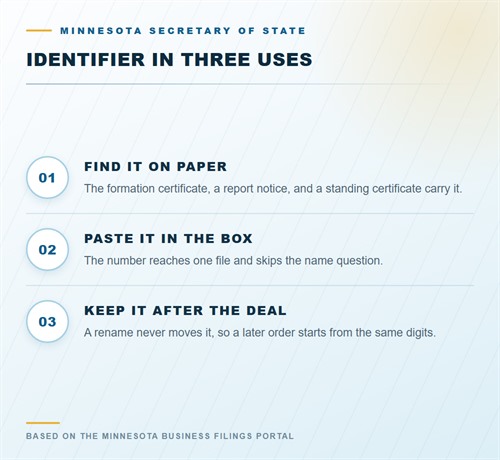
The number is short enough to fit on a certificate and long enough to identify one file among many. It is printed beside the legal name on every document the office returns, which is how a reader confirms that two papers belong to the same entity. The Minnesota business records page shows the documents that carry it.
Where the Number Comes From
The office assigns the number when it accepts the articles or the certificate of authority. The number appears on the formation certificate, on each renewal notice, and on the certificate of good standing. A company that converts from one class to another keeps the same number, which is why the identifier outlasts the class.
The number is issued once and never reissued, so two businesses cannot share it even when they share a name. That rule is what makes the identifier reliable in a contract file. A reader who records the number with the date of the lookup has a fact that survives a rename.
What the Number Is Not
The federal employer identification number comes from the Internal Revenue Service and serves a different purpose. A sales tax account number comes from the Department of Revenue, and a licence number comes from the board that issues it. A reader who confuses the four will search the wrong system and conclude that a record is missing.
Why the Number Matters
A name can change, and a similar name can belong to another business in another county. The number removes both risks, because it points to one file and one history. A reader who records the number with the name can return to the same record years later without repeating the search.
Minnesota business forms:
https://www.sos.mn.gov/business-liens/business-forms-fees/minnesota-limited-partnership-forms/
How to Find the Number
The number appears on several documents a business already holds. A formation certificate, a renewal notice, and a certificate of good standing each carry it, and a bank file usually keeps one of them. A reader who has none of those documents can find the number from the register by searching the name.
A founder should write the number on the first page of the company record book, because every later request starts with it. A bank that opens an account, a licence board that reviews an application, and a lawyer drafting an agreement all ask for the same identifier. Keeping it in one place saves a search each time.
On the Formation Certificate
The certificate the office returns after a filing carries the legal name, the file number, and the filing date. It is the paper a founder sees first, and it belongs in the company binder. A copy kept with the operating agreement answers a later request without a search.
On the Renewal Notice
The office sends a renewal notice to the registered agent before the due date, and the notice carries the number. A company that changed its agent may not receive the notice, which is why the agent field has to stay current. The confirmation after the renewal also shows the number.
A company that changes its registered agent should confirm the new address with the office before the next renewal season. A notice sent to the old agent may never reach the business, and the number will not appear on a notice the owner never sees. The agent field is the delivery route for the reminder.
From the Register by Name
A reader with no document can search the register by the distinctive word and open the record that matches the business. The result list shows the number beside each name, so the search answers the question in one lookup. A close name in another class is the reason to compare the office and the class before choosing.
Searching by the Number
The portal accepts the number in its own field, and the record opens without a list. A reader should paste the number exactly, because the field treats it as a single token. One dropped digit returns a blank page instead of a close match, which reads as a missing file.
A reader who pastes the number and sees a record with a different name should not assume the wrong page loaded. The name may have changed through an amendment, and the history will show the earlier one. Read the history before concluding that the record belongs to another business.
Exact Entry
Copy the number from a document rather than retyping it, and remove spaces if the field rejects the entry. A number read from a screenshot can carry a character that looks like a digit. When the first attempt fails, compare the number with the certificate before trying a different route.
A number pasted from a PDF can carry a trailing space that the field rejects, and the error looks like a missing record. Trim the entry before trying a second time. A reader who tries the name route after one failed paste usually finds the record in a minute.
When the Search Returns Nothing
An empty result usually means the number belongs to another system, such as a tax account or a licence. It can also mean the entity was filed under a different class and the number was transcribed incorrectly. A name search settles the question, because the register lists every class in one place and shows the number beside each result.
Records the Number Unlocks
The number leads to the record, the document list, the status, and the certificate order. A reader who needs a certified copy names the number on the request, which reduces the chance of a wrong file. A reader who needs a certificate of good standing uses the same number.
A certificate order placed with the number and the class moves faster than one placed with a name alone. The clerk can locate the file without a search, and the order is less likely to be returned. The number is the detail that turns a request into a task the office can complete.
Number, Name, and Class
The three fields work together, and each one answers a different question. The number identifies the file, the name identifies the business in the market, and the class identifies the statute that governs it. A reader who records all three can describe the entity to a bank, a lawyer, or a colleague without ambiguity.
A reader who describes an entity to a bank should give the number, the legal name, and the class in that order. The bank can then match the file without asking a second question. A description that begins with a brand name invites a search that returns the wrong record.
Name Changes
An amendment changes the name and leaves the number in place, so the history shows both names against one identifier. A contract signed under the old name still points to the same file. A reader who searches the former name may find the record through the history rather than the current name.
Class Changes
A conversion changes the class and keeps the number, which is why a record can show an LLC history under a corporate class. The document list shows the conversion as an entry, and the earlier filings remain available. A reader who needs the pre-conversion text orders the earlier document by its date.
A record that shows a conversion is the file a reader needs, because the number covers both classes. The pre-conversion document shows how the entity began, and the post-conversion document shows what it became. A buyer who reads only the current class misses half the history.
Successor Entities
A merger creates a successor with a new number and ends the earlier files, so a reader who follows a contract may need two numbers. The merger document ties them together, and a certified copy is the evidence a lender accepts. The history of each file shows the merger as its final or first entry.
Records the Number Reaches
The number opens the record and the documents attached to it, and it does not open the tax account, the licence, or the court file. A reader who needs those records has to use the number as a reference in a request to another office. The number is the shared thread across the four systems.
The number reaches the corporate file and stops at the other systems, which is why a complete review uses it as a reference rather than as a key. A tax request that quotes the number moves faster, and a licence request that quotes it moves faster still. The number is the reference that ties the four files together.
The Entity Record
The record shows the name, the class, the status, the office, the agent, and the document list. It is the first page a reader sees after a search, and it answers most of the routine questions. A reader who needs a document copies the type and the date from the list.
Filed Documents
The documents include the formation filing, amendments, renewals, mergers, conversions, and closures. Each one carries a date and a type, and a copy can be ordered by naming both. A certified copy adds a stamp that a bank or a court will accept.
Certificates
The certificate of good standing states the condition on a date, and it is ordered with the number. A certified copy of a filing carries the same number, and it is ordered the same way. A reader who needs both should order them together to save a session.
Using the Number in a Contract File
A contract file that names the entity, the number, and the class is easier to defend than one that names only the trading name. The number proves which file the parties meant, even when the name has changed. A lawyer who drafts the agreement can add it to the party description, and a lender who reviews the file reads it before the signature, because a dispute is easier to resolve with it. For a lease, the number belongs beside the tenant name in the same way, since a landlord may search the register before a renewal, and the same note answers a lender who asks later.
Drafting the Party Description
The description should read as the legal name, the class, and the state of formation, with the number in parentheses. That wording ties the signature to the register and survives a rename. A contract that names only a brand invites a later argument about which entity signed.
Checking the Number at Signing
A buyer should open the record on the day of signing and compare the status and the name with the draft. A lapse between the draft and the signature is the case the check is designed to catch. The printout with the date belongs in the file beside the signed copy.
Keeping the Number After Closing
The number stays useful after the deal, because a later request for a certificate or a copy starts with it, and the class beside it tells the clerk which form to pull. A file that keeps the number on the first page saves a search years later, and the note should carry the class beside the number so the next reader knows which form to order. The number also helps when a successor entity takes over the contract.
When the Number Is Not Available
A reader who has no document and no reliable name may still find the record through another identifier. A registered agent search, an assumed name search, or a certificate order can produce the number. Each route starts with something the reader already knows.
A reader with no document can begin with the address on a letter, because the office and the agent sit on the record. A search on the agent name is the practical fallback when the legal name is uncertain.
Starting From the Agent
A commercial agent appears on many records, and a search on the agent name returns the clients that use it. That list is long, but it narrows when the reader adds a word from the business name. The agent route is useful when the legal name is uncertain.
A reader who searches an agent name should narrow the list with a word from the business before opening any record. An agent can represent dozens of clients, and the list alone does not identify the file. The office and the class beside each result are the fields that separate them.
Starting From the Brand
An assumed name certificate names the owner and the legal entity, so a search on the brand returns the number behind it. A brand without a certificate leaves no trace in the index, which is itself worth recording. A buyer who finds no link should ask the seller for the entity name.
A brand search is a two-part check: the assumed name index for the certificate and the entity record for the owner. A brand with a certificate and no active owner is a warning, and a brand with no certificate is a question. The Minnesota assumed name records page covers the first part.
Number Fees
The lookup by number is free, and the charges below apply to the documents a reader orders with it. The certificate costs less by mail than online. A copy and a certification carry separate charges.
| Item | Online | |
|---|---|---|
| Lookup by file number | $0 | $0 |
| Copy of a filing | $3 | $3 |
| Certificate of good standing | $5 | $15 |
| Certification of a copy | $5 | $5 |
| Copy of a renewal notice | $3 | $3 |
| Annual renewal, active entity | $0 | $0 |
Frequently Asked Questions
These questions come from readers who hold a document and need the record behind it. Each answer names the field or the office at issue.
Is the number the same as the EIN?
No. The file number comes from the state, and the EIN comes from the Internal Revenue Service. A search on one will not return the other, and a form that asks for both is asking for two separate documents.
Does the number change when a company renames itself?
A rename is filed as an amendment, and the number survives it. The history lists both names against the same file, so a reader can trace the change.
Can I search by number without the name?
Yes. The number field opens the record on its own, which is why a reader who holds a certificate can skip the name question.
Where do I find the number if I have no documents?
Search the register by the distinctive word, or use the assumed name index when the business trades under a brand.
Does a dissolved company keep its number?
The file keeps its number after a closure, and the history shows the date the office closed it. A reader can follow the record once the business ends, because the earlier entries stay in place and the identifier never moves to a new file.