

Minnesota business filings and certificates are the documents the Secretary of State’s office issues after it accepts a filing, and they are what a bank, a landlord, or another registry reads. The office produces the formation certificate, the renewal confirmation, the certificate of good standing, and plain or certified copies of anything on file. Each one answers a different question, and ordering the wrong one costs a fee and a delay.
This page covers the documents a business is most likely to order, the difference between a certificate and a copy, the routes for an online or mailed request, the charges the office publishes, and the records that sit outside its control. It is written for founders, owners, buyers, and lenders who need the right paper rather than a printout.
How to Order Minnesota Business Filings
The portal accepts a request for a certificate or a copy, and the order is tied to the entity file number and the document type. A mailed request follows the same path with a cheque or money order. Both routes return a document with the office seal, and the online route is faster. The document desk sits inside the register, and Minnesota business filings on the front page is where an order begins.
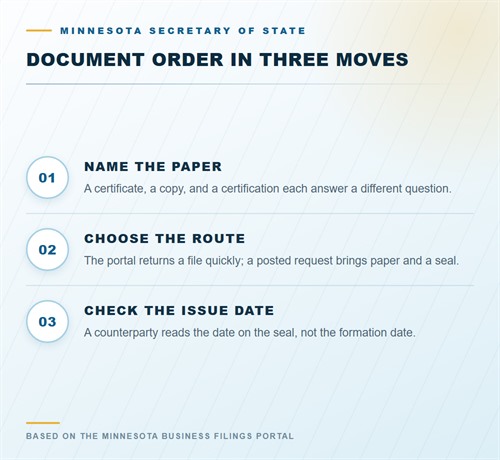
A reader who orders the wrong document usually learns about it at the counter, which is the most expensive place to find out. The counterparty usually names the document it will accept, and the request should follow that name rather than a guess. The Minnesota business records page shows where each document sits in the file.
Online Orders
An online order produces a downloadable file, and the account history keeps the receipt. A certificate ordered online carries the same statement as a mailed one. A counterparty that insists on a raised seal should be told the mail route is slower but available.
An online order that clears payment produces a document the same day in most cases. A certified copy of a long document may take longer because each page is checked. The account history keeps the receipt for both.
Mailed Orders
A mailed request goes to the office in Saint Paul with the entity name, the file number, the document type, and the charge, and it should include a telephone number and an email address so the office can ask a question rather than return the document. The paper copy arrives with a seal, and the postal time is added to the processing time. A request that arrives without the number is the one that waits, so both stages belong in the closing calendar.
What a Request Needs
The legal name alone can be ambiguous when several entities share a word, so the file number removes the doubt. A request that names a trading name rather than the legal name may be returned for clarification. The document type and the filing date belong in the request when a copy is ordered.
A request sent by post should include a return envelope when the office must send paper back, because the reply address is the one on the cheque. A request that names the type and the date can be completed without a question. An order that names two documents on one line slows the clerk, so list each item separately. One that says only “the certificate” waits for a reply, and the reply adds a day. A reader who copies both fields from the record avoids the exchange entirely.
Minnesota fee schedule:
https://www.sos.mn.gov/business-liens/business-filing-and-certification-fee-schedule/
Formation Documents
The formation document is the certificate the office returns after it accepts the articles or the certificate of authority. It shows the legal name, the file number, the class, and the filing date. It is the first document a founder receives, and it belongs in the company record book.
A founder should keep the formation certificate with the operating agreement or the bylaws, because the two are requested together in a bank review. A certified copy of the certificate is the version a foreign registry accepts when the entity registers in another state. The Minnesota corporation records page shows the corporate version of the same document.
Certificate of Organization
An LLC receives a certificate of organization after the articles are accepted. The certificate is evidence of the formation rather than a licence, and it does not expire. A copy is enough for a bank that is opening an account, while a certified copy is needed for a registry.
Certificate of Incorporation
A corporation receives a certificate of incorporation, and a nonprofit receives a similar document with its own class. The certificate carries the file number and the date, and it is the paper a lender asks for at the start of a relationship. A certified copy is the version a foreign registry accepts.
Foreign Authority
A foreign entity receives a certificate of authority after the application is accepted. The certificate shows the home jurisdiction and the Minnesota authorization date. A reader who compares the two dates can see when the entity began operating in the state.
The authority document carries the home jurisdiction and the local date, which can sit years apart.
Amendments and Mergers
An amendment changes a name, an address, an agent, or the share structure, and the office returns a confirmation when it accepts the document. A merger combines two entities into a successor, and a conversion changes the class. Each filing carries its own document and its own charge.
A confirmation is easy to lose because it arrives as an email rather than as a certificate. A company that keeps every confirmation in one folder can answer a buyer without a search. A missing confirmation can be replaced with a copy from the portal.
Amendment Confirmations
The confirmation shows the document type and the date, and it belongs with the earlier certificate. A buyer who reviews a file uses the sequence to account for a name change or an address change. A missing confirmation leaves a gap that a copy can fill.
A confirmation that arrives by email should be saved to the company folder rather than left in the inbox. A buyer who asks for the sequence of changes reads the folder, not the mail account. The confirmation carries the date that a timeline needs.
Merger Documents
A merger filing creates the successor and ends the earlier entities, and the document ties the files together. A certified copy is the version a lender accepts when it needs the chain of succession. The successor record carries the combined charter.
Annual Renewals
The yearly renewal keeps the registration live, and the receipt proves it landed. The renewal itself is free for an active domestic entity, and the confirmation shows the date the office processed it. A company that files in December has a clean record for the next year.
The renewal confirmation is the proof that the entity stayed current, and a file that holds the last three confirmations answers a lender in a single review. A renewal filed in January gives the rest of the year a clean record. A lapsed renewal shows a gap that a certificate cannot hide.
Renewal Confirmation
The confirmation is short, and it carries the entity name and the date. A buyer who asks for the last two confirmations is checking that the entity has stayed current. A confirmation that is missing from the file can be replaced with a copy from the portal.
Reinstatement Filings
A reinstatement brings a dissolved entity back, and the confirmation shows the recovery date and the entity that was restored. The record keeps both the dissolution and the reinstatement, so a reader can see the gap. A bank that reviews the file may ask for the reinstatement beside the certificate, and a certified copy is the evidence it wants.
Certificates of Good Standing
The certificate of good standing confirms that an entity exists and states its condition on the issue date. It is the document a bank, a landlord, or a foreign registry asks for, because it carries a seal and a statement. It does not list owners and does not certify a licence.
A certificate that is ordered for a bank should be ordered close to the closing date, because the bank applies its own age limit. A certificate that is ordered for a foreign registry should follow that registry instruction. The same document can fail two different tests if the date is wrong for one of them. A registry abroad may also ask for an apostille, which a separate office issues.
What It States
The document carries the name, the number, the class, and the condition on its issue date. Revenue, ownership, and tax standing are outside its scope.
The certificate names the entity and the date, and it states the condition in one sentence. A reader who needs the address or the agent should use the register printout beside it. The certificate is a statement rather than a summary.
When to Order
Order a certificate when a counterparty requires a dated document, when a bank opens an account, or when another state needs proof of existence. The order is handled online in a few minutes, and the certificate arrives by email or by mail. A file older than the counterparty limit is refused even when it is genuine.
A file that needs a certificate for a bank should order it when the closing date is fixed, not when the deal is first discussed. A certificate that is too old is refused, and a second order costs a second fee. The date on the page is the fact the bank reads.
Certified and Plain Copies
A copy reproduces a document on file, and a certified copy adds a stamp that confirms the reproduction. The text is the same, and the difference is the attestation. A court, a registry, and most banks ask for the certified version.
A certified copy is the one a court accepts, and a plain copy is the one a working file needs. A buyer who orders the plain version first often pays twice. The counterparty instruction is the deciding factor.
Plain Copies
A plain copy serves a working note or a call with the company, and the charge is per image. The file arrives by download, which is enough for internal use. A reader who needs a sealed version orders the certified copy instead.
A plain copy is enough for a working paper, and a certified copy is the version a court accepts. A reader who keeps both in the file can answer either request without a second order. The plain copy is the cheaper item.
Certified Copies
The order names the document and its filing date. Without both, the desk cannot locate the page. The certification charge is small, and the delay is the cost that matters.
What the Office Will Not Certify
The office certifies what sits in its own file, and nothing else. It will not state that a company pays its tax, owns its equipment, or holds a licence, because those facts live with other agencies. A request for such a statement comes back unanswered, and the delay can cost a closing date.
When a counterparty asks for more than the file can prove, the answer is a second document rather than a different certificate. Tax standing comes from the Department of Revenue, a licence from the board that issues it, and a lien from the county recorder. A reader who supplies those papers beside the standing certificate gives the counterparty a complete set.
Listing Every Document
A certificate that lists every document on file is the version a buyer orders when the history matters more than the current condition. It shows the types and dates, it supports a diligence summary, and it carries a higher charge than a single-fact certificate.
Other Facts
A single-fact certificate is cheaper and answers one question, such as the current name or the formation date. A reader who needs one fact should order the smaller document rather than the full list. The choice is a matter of scope rather than of accuracy.
A single-fact certificate is the cheapest way to answer a narrow question, and the full list is the version a diligence file wants. A reader who orders the larger document for a small question pays for scope that no one reads. The scope is the decision.
Processing and Delivery
An online order is processed in the order it arrives, and a mailed order follows the same queue with postal time added. An expedited request moves the document ahead for an added charge. A closing date should be set with the processing time in view.
A request that arrives on a Friday can sit until the next business week, and a closing on a Monday will miss it. A reader who plans the order around the calendar avoids the rush charge. The office processes in the order the requests arrive.
Timing
An online certificate is usually available in the same session, while a mailed certificate takes a week or more. A certified copy of a long document takes longer because each page is checked. A reader who needs a document for a date should order early rather than pay for speed.
A closing that depends on a paper certificate should allow a week for delivery, and a foreign registry may add a courier stage, which can push the date by several days. A domestic bank that accepts an electronic copy can be satisfied the same day. Ask which format the counterparty accepts before ordering.
Delivery Options
A downloadable file can be forwarded to a bank the same day, while a paper copy can travel to a registry by courier, which adds a stage. The office does not guarantee a delivery date beyond its own processing.
Delivery and Timing
An electronic order usually arrives within minutes of payment, while a posted request adds transit in both directions. A closing that depends on paper should allow a week, and a request sent to a registry abroad can add a courier stage on top of that. Order early enough that a correction can still be made before the date.
A request for several documents should list each one on its own line, with the date beside it. A single order for a certificate and two copies moves faster when the clerk can match every line to an entry, and a short cover note saves a round of questions. Keep the confirmation number with the receipt, since it is the reference for a missing item. An order that arrives without the identifier comes back for clarification, and that exchange costs more time than the request itself did.
Filing Fees
The office publishes a charge for each document, and the list below covers the items a business or a buyer is most likely to order. The certificate carries a lower mailed amount and a higher online amount. A copy and a certification carry separate charges.
| Document | Online | |
|---|---|---|
| Good standing certificate | $5 | $15 |
| Copy of a filing | $3 | $3 |
| Copy of an amendment | $3 | $3 |
| Certification of a copy | $5 | $5 |
| Articles of organization, LLC | $135 | $155 |
| Articles of incorporation, nonprofit | $70 | $90 |
Frequently Asked Questions
Owners, buyers, and lenders asked the questions that follow, and each one turns on the right document.
What is the difference between a certificate and a copy?
A certificate states a fact about the entity on a date, while a copy reproduces a document that was filed. A certified copy carries a stamp that confirms the reproduction.
How long does a certificate take?
An online order is usually available in the same session, and a mailed order takes a week or more. Expedited service moves the request ahead.
Does a certificate expire?
No expiry date is printed, yet most institutions want one dated inside the past thirty to ninety days.
Can I order a document for a dissolved entity?
Yes. The record remains on file, and the copies and certificates can still be ordered after the closure.
Is a formation certificate a licence?
No. It proves that the entity was formed. A licence comes from the board or the city that regulates the activity.