

A Minnesota limited liability company comes into being on the day the office takes in its Articles of Organization, and from then on the file grows by amendment and renewal. The same public register lists the company beside every corporation, nonprofit, and trade name in the state. A search returns the company name, the identifier, the condition, the street address, the accepting party, and the papers on record.
What follows tracks the LLC file through its life: the ways to reach it, the blocks a reader should study, the organizing document, the members and managers the state does not publish, the yearly report, the path back from a lapse, the papers that move a name or an office, and the closing statement. Owners, suppliers, and lenders can all use one route.
How to Search Minnesota LLC Records
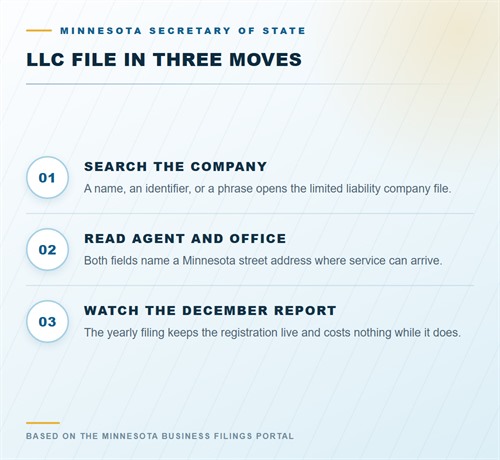
A single box handles three kinds of input, and any of them will open the company file. A sign or an invoice gives you a name to type; a certificate gives you a number that goes straight to the record. Neither path asks for registration, and the answer costs nothing. A reader who wants the whole register rather than one class can start at Minnesota LLC search on the front page.
There is no separate LLC catalog, so one query can pull a nonprofit, a corporation, and a brand that happen to share the wording. The filter is the tool that trims the list to the class you want. The Minnesota business status page describes how the condition field changes the way a record should be read.
Search by LLC Name
Enter the distinctive portion of the name and leave the ending out on the first pass. A query for “Lakeside” returns companies, corporations, and assumed names that share the word, and that wider list is what shows a near match filed under a different ending. The register sets the designation aside when it compares names, so an LLC can sit close to an existing Limited Liability Company.
Search by File Number
The office issues the number with the organizing document, and it accompanies every later paper the company sends, a rename included. Read it off the organizing certificate or a standing certificate instead of a commercial directory. A single slipped digit produces no result at all, and that blank screen can be taken for a company that never filed.
Comparing Similar Results
Sort a long list by status and then by filing date. An active company with a recent filing date is usually the one trading today, while a dissolved record with a similar name belongs to an earlier attempt. Compare the registered office and the agent with the address on the invoice. When two active records share a name, the file number and the addresses separate them.
Two companies can carry one name and sit in different counties, and the identifier separates them without a telephone call. Keep a running note as you scan: number and county for every near match, written before any file is opened. That habit stops two similar companies from merging in your notes.
Minnesota LLC forms:
https://www.sos.mn.gov/
What an LLC Record Shows
An LLC record is a filing file, not a business profile. It reports the legal name, the entity class, the current status, the dates attached to each document, and the addresses the company declared. It does not report revenue, employees, customers, or credit history. The file answers whether the company exists, who accepts service for it, and what it has filed.
The dates turn the entry into a story, and that story usually settles the question a lookup was meant to answer. A move that posted before a lease was signed is context, not a contradiction. A renewal that followed a quiet gap speaks of recovery rather than of a perfect record.
Identity and Status
Name and identifier pin down which company you are reading, and the condition answers whether the registration still stands. A company that has renewed carries an active label; one that let the report slide can be closed by the office. Closure leaves a dated entry that never disappears. Note the day you looked, since a condition can shift inside a single quarter.
Registered Office and Agent
Service of a claim requires a street address in the state and a named party willing to accept it. Neither field may be a post office box. Readers often mix these up with the business address, which is where the work happens rather than where a summons goes.
Filing History
Every accepted paper appears in sequence, from the organizing document to the closing statement, with mergers and agent notices slotted where they happened. Each line gives the paper type and the day it posted. A long silence proves nothing, because a mailed document can land weeks after it was signed. Use the list to find a paper, and use the condition to judge the present.
Forming a Minnesota LLC
The organizing document itself takes minutes to fill in, and the preparation around it takes the time. Before signing, the organizer settles on a name the register will accept, supplies a street address inside the state, and lines up a party to accept service. The office approves the paper, assigns the identifier, and the company dates from that acceptance.
The form then takes under an hour, and the tax registrations follow over the next few days.
Articles of Organization
The form asks for the company name, the registered office, the agent, and the signature of the organizer. Minnesota does not require a purpose statement on the standard form, which makes the filing shorter than in some states. A professional company governed by the professional statute adds the required statement about its licensed service.
Name and Office
The name must be distinguishable from every entity and assumed name on file, and it must carry an accepted LLC ending. The registered office must be a physical Minnesota address where a process server can appear. A commercial office or an agent address works, and a home office works when the owner accepts delivery there.
Filing Route and Charge
The articles can be filed online through the portal or mailed to the office in Saint Paul, and the charge differs by route. Online filing is faster and returns an electronic certificate. A mailed filing costs less and takes longer. A rejected document is returned rather than refunded, so check the name and the signature before submitting.
Members and Managers
Minnesota does not publish a member list for an LLC, and the public file does not identify the owners. The articles name the registered agent and the office, and the renewal confirms the address, but neither document exposes a membership schedule in the searchable register. A buyer who needs the ownership picture has to request it from the company.
A single-member company still benefits from a short agreement, because the document names the owner and the exit rule. A multi-member company should treat the agreement as the first piece of paperwork, not the last. A lender may ask for it before it accepts a guarantee, and a buyer will ask for it during diligence. The Minnesota business records page shows what else belongs in that file.
What the Office Publishes
The public file shows the company name, the file number, the status, the addresses, and the filing history. It does not show capital contributions, percentages, or manager titles unless a later amendment restates them. A person-name search can return the record when that person is the registered agent, which is a role rather than an ownership interest.
Operating Agreement
The operating agreement is an internal document, and Minnesota does not require it to be filed. It sets out the ownership percentages, the voting rules, the distribution schedule, and the process for admitting or removing a member. Because the state file does not carry it, a buyer or a lender who needs those terms has to ask for the document.
What a Lender Asks For
A bank that lends to an LLC usually asks for three items: a standing certificate with a recent date, the operating agreement, and the resolution that authorizes the borrowing. The state file supplies the first, the company supplies the second, and the members supply the third. A file missing any one of them slows the approval.
Where the company has changed its name or its agent since the loan papers were drafted, the lender may ask for the amendment as well. A folder that holds the organizing document, every amendment, and the current certificate answers the request in one pass. Keep the same set for each company in a group, because a lender often reviews them together. A member who signs a personal guarantee should keep a copy of that paper with the entity file, since a lender calls on it first when a payment is missed.
The Annual Renewal
The yearly report is the one recurring duty a live Minnesota LLC carries, and a domestic company in good standing owes nothing to send it. The report restates the street address and the accepting party and keeps the company on the active roll. The window shuts with the calendar year, though the screen opens for business well before the last week.
Sending the report in the first days of December dodges the queue that forms near the thirty-first, and the receipt pins the date. An owner with several companies renews each file separately, and the account holds the receipts together. If the agent moved during the year, correct it in one place only, either on the report or on a separate notice.
Deadline and Route
The report must reach the office by the final day of December, and either an electronic or a posted version will do. Last year answers appear on the screen as a starting point, and each one needs checking. Any address or agent that changed since then has to be edited on the spot, not carried forward.
Why It Is Free
The state keeps the report separate from any tax account. It exists to confirm that the company still answers at a known address, so a current domestic LLC owes nothing for it. Payment enters the picture only when a closed company asks to return, and that is the reason a lapse runs dearer than a punctual report.
Losing Good Standing
When the report never arrives, the Secretary of State can close the company without a vote from the owners. The business may keep its equipment and its debts, yet the file stops vouching for it. A return filing puts the company back among the active, and the record retains both the closure and the comeback.
A closure discovered months afterwards can still be reversed, and the interval stays on the record. The real expense is the holdup: a lender, a property manager, or a licensing office can freeze a matter until the label flips back. An alarm set for November costs nothing and prevents the entire chain.
Administrative Dissolution
The closure appears once the reporting window shuts, and no judge and no member vote are required. A company that keeps operating afterwards does so without authority, and its agreements become awkward to enforce. A bank can lock an account the day it spots the label, and a landlord can call the lease broken.
Reinstatement
A reinstatement filing brings the company back, and it carries a charge that depends on the route. The company files the current renewal with the reinstatement, and any missing year is settled at the same time. Approval puts the company back on the live list, and the record then carries a new certificate.
The return application arrives alongside the current report, and the clerk reads both at once. Every year that went unpaid is settled in the same pass, and the total reflects the length of the absence. File the receipt next to the organizing certificate, because a lender may ask for the sequence.
Amendments and Agent Changes
Two instruments alter an LLC file, and they are not interchangeable. A new name, a revised purpose, or a restated document goes through an amendment. A switch of street address or accepting party uses the shorter notice form. Either way, the office posts a processing date and keeps the earlier entry visible.
Name and Address Changes
A name change requires a cleared new name before the amendment is filed, and the old name stays in the history. The company updates its bank accounts, licences, and contracts after the office accepts the amendment, because the state record does not notify those offices. An address change follows the same pattern.
Agent Notices
The notice names the outgoing agent and the incoming one, and the incoming party accepts the role. The new agent must hold a Minnesota street address, and the company cannot act as its own agent. The change takes effect when the office processes the notice, and a resignation without a replacement leaves a gap.
Closing an LLC
An LLC ends through a statement of dissolution or a statement of termination. The filing states that the company has wound up its affairs, and the office closes the record when the document is accepted. The record then shows a dissolved status, and the company stops filing renewals. A company that closes without filing leaves an active record behind.
A company that closes in good standing leaves a cleaner history than one that lapses and is reinstated. The difference is visible to a buyer who reads the record, and it can affect how the owners are treated in a later transaction. Filing the final renewal before the statement is a small task that protects the record.
Before the Filing
Before the statement is filed, the company should settle its tax accounts with the Department of Revenue and close any local licence attached to the address. A dissolution with the office does not cancel a tax account or end a lease. Creditors can still pursue a dissolved company for obligations that predate the closure.
Dissolution Charges
The closing statement costs little next to the price of leaving a file open by accident. Before sending it, check where the next reporting date falls, because a report that comes due first will reopen the question. Sending that report keeps the history tidy through the final day.
A company that closes without settling its tax account may still receive a notice from the Department of Revenue, because the office and the tax department do not share a closing action. The statement ends the registration, and the tax account needs its own request. The owners should keep the confirmation from both offices with the final records.
LLC Fees
The office publishes a charge for each LLC filing, and the table below covers the documents a company is most likely to order. Most filings carry a lower mailed amount and a higher online amount. The annual renewal for an active domestic company is free.
| LLC filing | Online | |
|---|---|---|
| Articles of organization | $135 | $155 |
| Annual renewal | $0 | $0 |
| Annual reinstatement | $65 | $85 |
| Certificate of good standing | $5 | $15 |
| Amendment | $35 | $55 |
| Change of registered office or agent | $35 | $55 |
| Statement of dissolution | $35 | $55 |
| Certification of a copy | $5 | $5 |
| Copy of a filing | $3 | $3 |
Frequently Asked Questions
Owners, buyers, and agents sent these questions about Minnesota LLC files, and each reply points to the filing or the field involved.
Is the Minnesota LLC search free?
Yes. The public register charges nothing for a lookup and needs no account. Charges apply to filings, certificates, and copies, not to the search.
Does Minnesota publish LLC members?
No. The public file shows the agent and the addresses, not the membership schedule. Ownership comes from the operating agreement or from the company directly.
Can one person own a Minnesota LLC?
Yes. One person can organize the company, hold every membership interest, and serve as the sole manager, and the agreement should still name the owner.
What happens if the annual renewal is missed?
The office can dissolve the company, and the record shows the dissolution. Reinstatement requires the current renewal and the reinstatement charge.
Does a foreign LLC file in Minnesota?
Yes, once it obtains a certificate of authority from the office. It then files the same renewal and keeps a Minnesota registered agent, even when its office sits elsewhere.
Is a certificate of good standing needed every year?
No. A certificate is ordered when a bank, a landlord, or another registry asks for one. The renewal is the filing that keeps the record active.