

Minnesota business name search leads a reader to the entry that holds a name rather than to a company profile, and that entry is the first thing to read when a name is in dispute. Every legal name, former name, reserved name, and trade name in the state sits in one index, and each entry shows which filing put the words there. A reader who knows how the index behaves can settle most name questions without a telephone call.
This page covers the way the register stores a name, the fields beside it, the traces that reservations and amendments leave, the names of foreign and closed businesses, and the papers that turn a screen entry into evidence for a bank or a court. It serves a founder testing a choice, a buyer reading a target, and a clerk checking a signature on a contract.
How to Search Minnesota Business Names
The query box accepts a word, a full legal name, or a file number, and it returns every entry whose stored text holds the term. The match is broad rather than exact, so a short word pulls a long list and a full phrase pulls a short one. Both shapes are useful, and the choice depends on what the reader already has in hand.
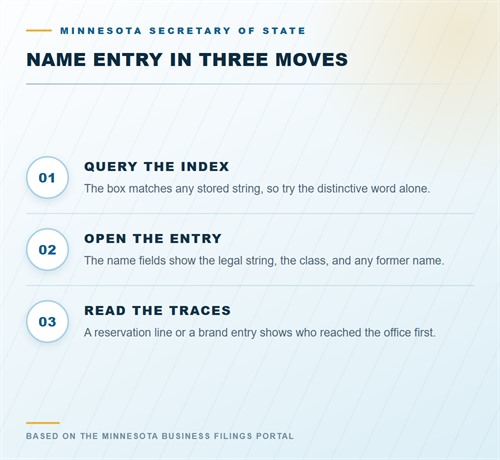
A founder testing a new choice should begin with the heart of the name, because the office sets the ending aside when it compares two records, and a query that keeps the ending can hide a near twin. A buyer chasing a known company should begin with the identifier or the exact legal name, since those routes skip the guessing that a keyword leaves behind.
The index behind the Minnesota business name search holds every class in one place, so a single query can return an LLC, a nonprofit corporation, and a trade name that share a word. Read the class before you read the name, because the class tells you which rules produced the entry and which filings will follow it.
Search by Keyword
Type the identifying word of the business and save the designation for a later pass. A query built on a place name or an invented word returns records from several classes at once, and that list shows how crowded the word already is. One hit on a distinctive term is a stronger signal than any guess about availability.
A word that describes the trade adds noise, because dozens of companies may carry it. Pair the descriptive word with the distinctive one to narrow the result, and write down the identifiers of the close records so a second search does not repeat the work.
Search by Identifier
A file number reaches one entry and skips the name question entirely. Numbers are issued when a formation document is accepted, and they survive a rename, so an old certificate still points at the live file. A reader holding any paper from the company should read the number off it first.
Where the number is unknown, the registered office or the agent name can serve as a route. Neither is unique, so expect several results and confirm the match on the class and the date. A wrong digit returns nothing at all, which can look like a company that was never registered.
Order of the Results
The list is not ranked by relevance, so the first row carries no authority. Rows are grouped by the way the index stores them, and a trade name can sit above a corporation with the stronger claim to the word. Sort by status or by date where the tool allows it, then open the entries that share the closest wording.
How the Index Treats a Name
The register compares stored characters rather than the way a name sounds, so a difference a customer would never notice can create two separate entries. Spacing, punctuation, and the designation all sit in that stored text, even where the comparison later sets them aside. Two records that read alike on a sign can therefore carry different strings.
The practical effect is that a reader should test more than one spelling. A hyphen, an apostrophe, or a doubled letter can push a record off the first page of results. Where the tool ignores a character, the same query returns both forms and the list shows the pair side by side.
Punctuation and Spacing
Commas, periods, and the ampersand are the characters that most often split two spellings apart. Search once with them and once without, and compare the entries that appear. A record filed as two words can hide from a query typed as one, and the reverse is just as likely.
Ampersands and the word “and” are separate strings, so a reader should try each form. Numerals behave the same way: a street number written as a word and a number written as a digit create different matches. When a result looks thin, the next spelling usually shows why.
The Designation in a Comparison
The office removes the corporate designation before it weighs two names for acceptance, but the index keeps the full string. That split accounts for a pair of results that seem to duplicate each other: one record shows the words with the ending and the other shows the same words under a different class. Read both before deciding which one matters.
A search that returns only the designation is not a search at all, because the word “LLC” appears on thousands of entries. The distinctive term is what narrows the list, and the designation is what tells the classes apart once the list is short.
The Name Fields on an Entry
An entry gives the legal name, the class, the identifier, the condition, the office, the agent, and the date of each document on file. The name field is the one that changes the least, so a mismatch there is worth a second look. A reader who checks the name alone and stops has read a fraction of the record.
Two entries can share a word and describe different businesses, which is why the class and the office travel with the name in every note. A name that looks identical on two screens can belong to a company in another county or to a brand held by a competitor. Where the brand is the question, the Minnesota assumed names page follows the certificate that ties a trade name to its owner.
Legal Name
The legal name is the string on the formation document, and it is the name that binds the company in a contract. A sign, an invoice, or a website can carry something shorter, and the difference is normal where a trade name certificate exists. A contract that uses the short form without the legal name leaves the signing party open to question.
Former Names
A rename arrives as an amendment, and the file keeps the earlier string beside the new one. The index may return the current entry for a query on the old name, or it may return a separate line that points to the change. Where the old name still sits on a licence or a lease, pair the amendment with the live entry before the paper is updated.
Reservation Entries in the Register
A reserved name appears as its own line, with the applicant, the class it is meant for, and the term printed on the confirmation. The line is evidence that someone reached the office first, and it is the answer a reader needs when a founder asks why a chosen name is unavailable. The entry does not mean a company exists under that name.
Reservation lines are short-lived, and a reader who finds one should note the date and the class. A term that has run out leaves the words free again, and a new filing can take them. The line drops from the active view once the term closes. The Minnesota name availability page covers the request that creates the hold and the review that follows it.
What the Entry Shows
The line carries the proposed string, the applicant, and the class. It does not carry an address, a purpose, or a document history, because no company has been formed. A reader who needs those facts is looking at the wrong kind of entry.
An applicant can be a person or an existing company, and the class field is what limits the hold. A corporation that reserves a name for a future subsidiary shows up under the corporate class, not under the LLC class it may later use.
When the Line Disappears
The line leaves the active list when the term runs out or when the applicant releases it. A formation filed under the reserved string replaces the reservation with a full entry, and the identifier changes at that point. A reader who watched a name vanish should check whether a company now holds it.
Name Changes Across the File
Most name changes arrive in one of four ways: an amendment, a merger, a conversion, or a restoration after a lapse. Each one leaves a different trace, and the trace is what a reader follows when the current name does not match an older document. The identifier stays put through three of the four.
An amendment is the ordinary route for a company that simply wants a new name. A merger folds one or more companies into a survivor, and the survivor keeps its own name while the others end. A conversion changes the class and can bring a new designation with it. A restoration returns a lapsed company to the active list under the name it held.
Amendment
The amendment states the old name and the new one, and the office posts both in the history. The identifier does not move, so a reader who follows the number arrives at the current entry and sees the change. A certificate ordered after the amendment carries the new name only.
Merger and Conversion
A merger ends the absorbed companies and leaves a survivor whose file carries the combined charter. A reader who searches the absorbed name finds a record with an end date and a note pointing to the survivor. A conversion keeps the file alive but swaps the class, and the name may gain a new designation in the process.
Names Held by Foreign Entities
A company from another state that wants to do business in Minnesota files for authority, and the entry shows the name it uses at home alongside the local registration. The home name can differ from the name it trades under here, and a reader should expect both fields. The class field marks the entry as foreign.
The home jurisdiction and the local date sit side by side, and they can be years apart. A company that registered late still holds a valid entry, and the gap is not a defect. A reader who needs the current standing reads the condition, not the first date.
The Registered Name
Where the home name is already taken in Minnesota, the foreign company can register under a different form for this state, and the entry shows that alternative. A reader who searches the home name and finds nothing should try the local form before concluding that the company never registered.
Home State Field
The home state field tells a reader where the charter was filed first, which matters when paper is needed for a registry abroad. A Minnesota certificate states the local registration and the home jurisdiction, and the pair is what a foreign bank usually asks for.
Names of Closed Businesses
A closed company keeps its entry, and the name stays in the index with an end date beside it. The words are not erased, so a search years later still returns the record and its history. That persistence is useful for a buyer and awkward for a founder who wants the same name.
A name held by a dissolved company may be free for a new filing, but the office decides that when the document arrives. The older entry stays visible either way, and a reader who sees it should check whether a newer company now holds the same string.
Dissolved and Revoked
A dissolution filed by the owners ends the registration, while a revocation comes from the office after a failure to file. The two carry different labels and different dates, and the label is what a lender reads. A revoked record can often be restored, and the history will show the break.
Reuse of a Retired Name
A retired name can return on a new file with a new identifier, and the two entries then sit in the same list. The older one keeps its end date, and the newer one carries the live condition. A reader who finds two entries with one name should compare the dates before assuming a mistake.
Turning a Name Entry into Evidence
A screen entry answers a question for the reader, but a bank, a landlord, or a court usually wants paper with a seal. The office issues two documents for that purpose, and each one proves a different thing. A reader should match the paper to the question rather than order the heaviest option.
A standing certificate confirms the company is on the register and reports how it stands when the clerk prints it. A certified copy reproduces a document already on file and confirms that the text matches the record. The first is what a counterparty asks for at signing, and the second is what a dispute requires.
Standing Certificate
The certificate carries the name, the identifier, the class, and the condition, and it is dated. It does not list owners, revenue, or licences, and it does not promise that the company will stay active. Most institutions want a recent issue date, so a copy from last year may be refused.
Certified Copy
The copy repeats a document on the register, such as the articles or an amendment, and a stamp confirms the match. A reader who needs the exact words that created or changed a name orders this version. The request names the document and the date, and the office pulls it from the file.
Name Record Fees
Nothing is charged for the lookup. The table covers the filings and papers that hold or prove a name. The mailed and online columns differ on most items. A formation carries its own charge, which sits on the entity pages.
| Name record item | Online | |
|---|---|---|
| Register lookup | $0 | $0 |
| Name reservation | $35 | $55 |
| Copy of a name record | $3 | $3 |
| Reservation renewal | $35 | $55 |
| Certified copy | $5 | $5 |
| Standing certificate | $5 | $15 |
Frequently Asked Questions
These answers address the entries that raise the most doubt in a name search.
Can I search a name without the exact spelling?
Yes. The box matches any entry that contains the term, so a partial word returns a list. Try the distinctive part alone, then add the ending if the list grows too long.
Why do two entries carry the same name?
Two files can hold one string when one belongs to a closed company and the other to a newer one, or when the class and the office differ. Compare the identifiers and the dates before treating the pair as an error.
Does a reservation mean the name is approved?
No. It records that the applicant reached the office first for a stated term. The formation document still has to pass review when it arrives.
Where does a trade name appear?
A trade name sits in the same index as the legal names, with its owner beside it and its term on the line. The certificate behind it is a separate filing that names the party that holds the brand.
What proves a name to a bank?
A standing certificate with a recent date is the usual paper. A certified copy is the answer when the bank wants the wording of a filing rather than a summary of it.
Why did an old name disappear from a search?
The index may keep only the current string on the main line, with the earlier one in the history. Open the entry and read the document list before assuming the older name was never filed.