
A Minnesota nonprofit corporation takes shape when the office accepts its articles, and the record then follows the same filing system that holds every profit company in the state. The exempt class keeps its own purpose clause, its own board, and a federal question the state cannot answer. A lookup shows the exempt name, the class, the identifier, the standing, both addresses, and the papers the office has taken in.
The sections that follow trace an exempt file from its first document to its final one: how to reach the record, what each block reveals, the articles and the purpose clause, the board and any members, the yearly report, the exemption that comes from Washington rather than Saint Paul, fundraising registration, and closure. Founders, trustees, funders, and buyers read the same file, though they look for different things.
How to Search Minnesota Nonprofit Records
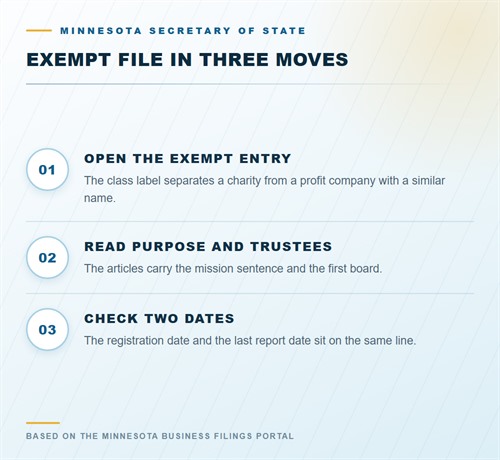
The portal returns every class in one list, so the class field is what separates a nonprofit from a business corporation. A reader types the name or the file number and opens the record that carries the nonprofit label. No fee is charged for the lookup, and no account is required. Any class can be reached from the front page, where Minnesota nonprofit corporation search opens the same index.
There is no charity-only index, so a query returns every type that carries the chosen word. A grant seeker may find a profit company with a similar name and a brand owned by someone else on the same page. The Minnesota corporation records page shows how the business class differs.
Search by Name
Begin with the word that marks the mission, and hold the corporate ending back for a second try. A word like “Community” returns several classes at once, and the class label tells you which result is the exempt one. Open the record whose street address matches the letterhead or the grant paperwork.
A reader who searches a mission word may find several organizations that share it, and the class beside each result is the field that separates a charity from a business. The registered office and the agent are the next fields to compare, because a similar name can belong to an unrelated group in another county.
Search by File Number
The identifier is created with the articles and never leaves the file, even after a rename. A certificate or a report notice carries the digits, which removes the name question entirely. For a charity that has changed its title, the number is the surest route back.
A reader who holds a grant letter or a certificate can use the number to reach the record in one lookup. The number also confirms that two documents belong to the same organization, which matters when an affiliate uses a similar name.
Read the Class Field
The class field reads as nonprofit corporation, and it sits beside the name and the number. A business corporation and a nonprofit can share a name pattern, so the class is what confirms the record. The class also tells a reader which renewal and which fee schedule apply.
Minnesota nonprofit forms:
https://www.sos.mn.gov/
What a Nonprofit Record Shows
An exempt file holds corporate papers and nothing more. It carries the corporate name, the exempt class, the identifier, the standing, both addresses, and every accepted document. Revenue, grants, and programs stay outside it, and the file says nothing about the federal exemption.
The record does not carry a program list, a budget, or a grant history. A donor who needs those facts should ask the organization for its annual report and its latest financial statement. The register proves the corporate facts and leaves the mission to the organization.
Identity and Status
Three fields point to the right organization: the name, the identifier, and the exempt class. A fourth tells whether the registration still stands. A charity that has filed its report reads as active, while one that skipped it can be closed by the office, and the closure carries a date.
A funder should read the standing and the last report date on one line, because a decade of registration is itself a signal. A current report beside an active label is what a grant officer can rely on, and a long silence before a revival deserves a question.
Registered Office and Agent
A claim against the charity must be deliverable to a street address in the state, and someone must agree to receive it. Box numbers are refused in both fields. The pair works as one arrangement, and a stale address can let a suit proceed without the board ever seeing the paper.
Filing History
The document list runs from the articles through every amendment and report, with the closing statement at the end where one exists. Each line gives a paper type and a posting date. Silence in the list means little, because a posted paper can lag the signature by weeks. Use the list to locate a document and the condition to describe the present.
Forming a Nonprofit Corporation
The articles bring the charity into existence, and the exempt version is shorter than the profit one because no shares exist to authorize. The organizer sets down the name, the street address, the accepting party, the mission, and the first trustees. The office accepts the paper and assigns the identifier.
Draft the mission sentence before the form, since the same words reappear in the federal packet. A clause drawn too tightly can fence in later programs, while one drawn too loosely invites a question from the reviewer. The balance names the work plainly and leaves space for related activity.
Articles of Incorporation
The articles state the corporate name with an accepted ending, the purpose, the registered office, the agent, and whether the corporation has members. A nonprofit that plans to seek federal exemption should draft a purpose and a dissolution clause that satisfy the federal test. The state form does not review that test.
The articles are short enough to complete in one sitting, and the office publishes a form and a set of instructions for the class. A missing signature or a box address returns the document without a filing, so check both before submitting. The filing date is the date the office accepts the document, not the date it was mailed.
Purpose and Dissolution Clause
The purpose describes the mission in a sentence or two, and the dissolution clause states what happens to the assets if the corporation closes. A clause that distributes assets to the members can defeat an exemption application. A founder should draft the clause with the federal rules in mind rather than after the filing.
A clause that sends the assets to a member or a founder is the most frequent mistake in a small nonprofit filing, and it can defeat an exemption application months later. A founder should copy the wording from the federal instructions rather than draft it alone. The expense of a short review is smaller than a rejected application.
Directors and Members
The articles name the initial directors, and the bylaws set the terms and the meeting rules. A nonprofit may have members or may be governed by a self-perpetuating board. The choice affects the annual renewal and the way a later change is approved, so it belongs in the bylaws rather than in a conversation.
Directors and Members
The board runs the corporation, and the members, where they exist, hold the ultimate authority over the board. The public record names the directors at formation and shows later changes when the corporation files them. The record does not list the members, and it does not show the minutes.
A board of three is the usual minimum for a small nonprofit, and the bylaws set the terms and the quorum. A board that meets once a year still needs minutes, because a grantor may ask for them. The record the office keeps is short, and the board book fills the gap.
What the Office Publishes
The record shows the directors named in the articles and any later update the corporation files. It does not show the officers, the committee structure, or the board votes, so a donor who needs the governance picture asks the organization for its bylaws and its latest annual report.
The Minute Book
The minutes, the bylaws, and the conflict-of-interest policy stay with the corporation. A grant application often asks for those documents, and a buyer of a program or a building may ask for the minutes that approved the transaction. A board that keeps the book current answers those requests in a day, while a minute book with missing years is a warning that the record was not maintained.
The Annual Renewal
Every Minnesota nonprofit files an annual renewal, and there is no charge while the corporation stays active and in good standing. The renewal confirms the registered office and the agent and keeps the corporation on the active list. The due date falls at the end of the calendar year.
Sending the report in the first week of December avoids the scramble at month end, and the acknowledgment fixes the date. A charity that holds several registrations reports each one separately, and the account stores the acknowledgments together.
Deadline and Route
The filing deadline is the last day of the year, and the office takes either an electronic copy or a posted one. Last year answers load as a draft, and the filer checks every line before it goes. Where the accepting party changed during the year, that field must be corrected in the draft.
An electronic submission returns an acknowledgment that the secretary can file with the minutes, while a posted one comes back as a paper receipt after a longer wait. Either satisfies the office, and the public entry changes once the paper posts.
Why It Is Free
The yearly report exists to confirm the address and the accepting party, not to raise revenue, so a current exempt corporation pays nothing to stay listed. Money is owed only when a closed charity asks to be restored. The arrangement is the reason a lapse ends up dearer than an on-time report.
Federal Tax Exemption
Saint Paul creates the corporation and Washington decides the tax status, and the two are separate acts. An organization that wants recognition sends the Internal Revenue Service a packet built on its articles, its bylaws, and a narrative of what it does. The state file proves the entity exists and says nothing about the exemption.
Send the exemption packet soon after the articles, since the determination letter is what unlocks foundation money. A slow application can leave the charity taxed on income it assumed was exempt. The Minnesota filings and certificates page lists the corporate documents an application usually needs.
The Application
The application asks for the organization’s purpose, its governing documents, and its finances. A small organization may use the shorter form, while a larger one files the full version. The IRS reviews the documents against the exemption test and issues a determination letter when it agrees.
The Determination Letter
The letter is the document a donor or a foundation asks for, and it carries the exemption section and the effective date. A state record does not replace it, and a state-approved name does not produce it. A buyer who needs the letter should ask the organization, not the Secretary of State.
A foundation that asks for the letter usually wants the section and the effective date on the same page. A copy of the state certificate does not answer the question. A new organization should keep the letter with the articles and the bylaws. A board should treat the determination letter as a file document, since a funder may ask for it beside the articles in the same review.
Fundraising and Registration
A nonprofit that solicits donations may have to register with the Attorney General’s charitable division, depending on the state and the amount raised. The registration is separate from the corporate filing, and it carries its own renewal. A founder who plans a public appeal should check the requirement before the campaign.
A public appeal can trigger a charitable registration even when the organization is small. A founder who plans a campaign should check the threshold before the first solicitation, because a late registration can delay a grant.
Charitable Registration
The registration asks for the corporate documents, the financial information, and the names of the officers. A small organization may qualify for an exemption from the registration, and the threshold is set by statute. The corporate record supports the application, and the charitable record proves the registration.
A registration that lapses can pause a grant while the organization restores it. A charity that changes its name must update the charitable registration as well, because the two records carry separate titles. The board secretary should own the calendar, and the treasurer should own the financial schedule, because the two filings fall on different dates.
Receipts and Records
A donation receipt states the amount, the date, and whether any goods or services were provided, and a donor who gives goods should receive a description of the property. The organization keeps a copy of each acknowledgment with the bank records for the period the tax rules require. A donor who needs a receipt for a deduction should ask at the time of the gift.
Closing a Nonprofit
A nonprofit closes through a statement of dissolution, and the filing states that the affairs have been wound up. The assets are distributed under the dissolution clause rather than to the members, and the final returns follow the closure. The record then shows a dissolved status and stays on file.
A closure requires a board vote and a distribution under the clause, and the minutes record both. A statement filed without the distribution leaves a question for the attorney general and for the next reader of the record.
Before the Filing
Before the statement goes out, the board settles its tax accounts, ends any fundraising registration, and moves the remaining property according to the clause. The minutes should record both the vote and the disposition. A closure that leaves assets unaccounted for hands the next reader a question.
After the Filing
The record shows the closure date, and the history keeps the earlier filings. A donor or a grantor who checks the record later can see that the corporation ended in the way the statute allows. A copy of the dissolution belongs with the final minutes.
A later reader who opens the entry sees a closed registration rather than a missing one, and that distinction matters to a funder checking a past grant. Keep the acknowledgment with the final minutes, because the office can replace a lost copy from the file.
Nonprofit Fees
The office publishes a charge for each nonprofit filing, and the amounts below cover the items a founder or a board is most likely to order. The two routes carry different amounts. The annual renewal for an active domestic nonprofit is free.
| Nonprofit filing | Online | |
|---|---|---|
| Articles of incorporation | $70 | $90 |
| Amendment | $35 | $55 |
| Annual renewal | $0 | $0 |
| Certificate of good standing | $5 | $15 |
| Change of registered office or agent | $35 | $55 |
| Certification of a copy | $5 | $5 |
Frequently Asked Questions
Founders, trustees, and funders sent the questions below, and each reply names the office or the document involved.
Is the Minnesota nonprofit search free?
The register is free to open, and no account is needed. Costs begin with a filing, a certificate, or a copy.
Does the state filing grant tax exemption?
No. The exemption comes from the Internal Revenue Service, and the state record proves existence rather than exempt status.
Does a nonprofit have members?
It may, and the articles state whether it does. A nonprofit without members is governed by its board under the bylaws.
Does a nonprofit file an annual renewal?
Yes. The renewal is due at the end of the calendar year and is free while the corporation stays active.
Can a nonprofit make a profit?
It can earn a surplus, and the surplus has to serve the mission. A distribution to a private individual can endanger the exemption.